If you’ve just moved onto a few acres and the grass is already past your knee, you’re learning fast that mowing acreage is a different game to mowing a backyard. Different gear, different timing, different cost. A push mower won’t cut it, literally. Get the wrong setup and you’ll spend every weekend playing catch-up. Get the right one, or hand it over to someone who’s already kitted out, and the property finally starts looking the way you pictured when you moved in. Here’s how acreage mowing actually works, what it costs, and where the trade-offs sit by property size.
What “acreage” actually means for mowing
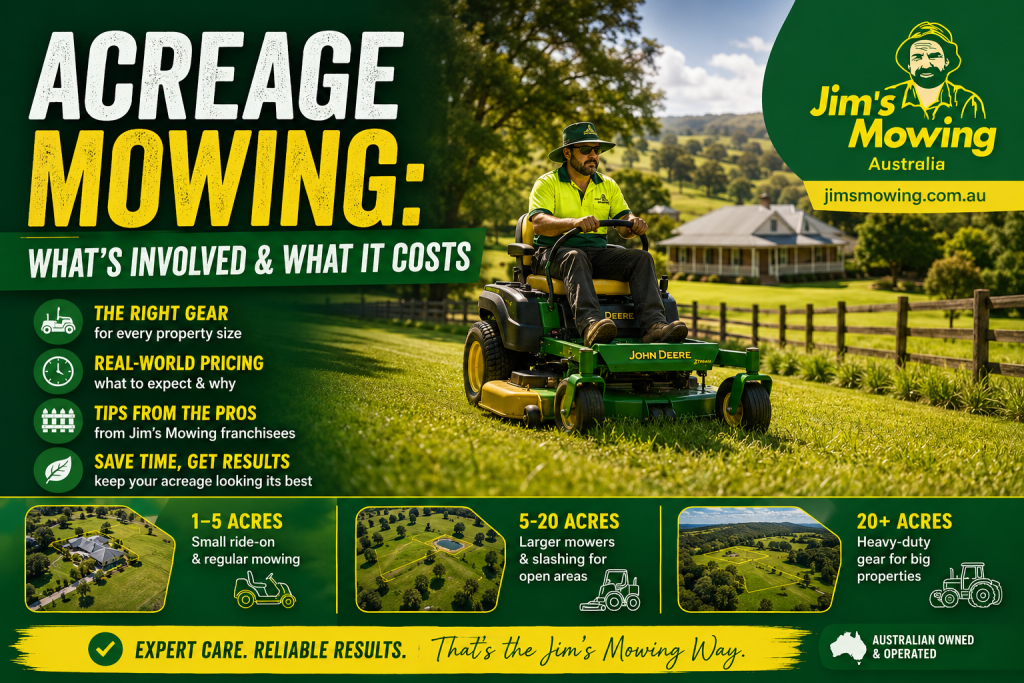
Acreage is a wide term. A 1-acre block in outer suburbia is a very different job to a 40-acre lifestyle property with cattle on one paddock and a manicured lawn on another. The size, terrain, fencing and end-use all change the gear and time involved. We split it into three working brackets:
- 1 to 5 acres: Usually a single ride-on job. Mix of mown lawn around the house, a few paddocks or open grass to keep tidy. Typically one team, one ride-on, one trailer per visit.
- 5 to 20 acres: Often a combination of mown lawn near the home plus larger areas that get slashed less often. Brush cutting fence lines, around trees and driveways adds significant time.
- 20+ acres: Larger commercial-grade gear, usually with livestock fencing to mow around. Some areas may be slashed once or twice a year rather than mown regularly.
Craig, who runs Jim’s Mowing Denham Court in Sydney, services one client across the whole spectrum.
“One client he’s got acreage, 37 acres. But I don’t do all that. He’s got cattle and sheep and stuff on it. But I do all his properties. He’s got 12 properties that I look after and maintain.”
— Craig, Jim’s Mowing Denham Court, on the Jim’s Mowing podcast
That’s an important point. On bigger blocks, the lawn that needs regular mowing is often just the area around the house. The rest is either paddock, slashed seasonally, or grazed by stock that does the work for you.
The equipment progression: how franchisees build up
Most of our acreage franchisees didn’t start with the gear they finished with. They built up as the jobs got bigger.
Craig’s path is a good example of how it usually goes. He started with a push mower and a basic trailer. As the work grew, he added a self-drive mower so he could keep up on the larger backyards. Then a ride-on for the proper acreage jobs. Then he upgraded the trailer to fit the ride-on. Then he added a small NLR truck so he could carry a ride-on on the trailer and a ride-on on the truck for the same day’s work.
The pattern goes push → self-drive → ride-on → bigger trailer → light truck. Each upgrade is paid for by the next size of job. As Jim’s franchisor John Wilds puts it in his training, a ride-on is worth buying once you have a single job that justifies it. From there, the bigger gear unlocks bigger work.
For homeowners, the lesson is similar. Buy the smallest mower that genuinely fits your property. Anything bigger sits in the shed half the year. Anything smaller wears out fast.
Gear by acreage bracket: what’s actually used
1 to 5 acres
A small ride-on in the 32 to 42 inch deck range is the sweet spot. Big enough to cut hours off your weekend, small enough to fit through a standard garden gate.
Mitchell Dennis, who works the Dandenong foothills patch out of Belgrave Heights, runs a 32-inch Scag for exactly this reason.
“”I’ve got the 32-in Scag in the back here… It’ll fit through a lot of gates. So I’ll just go into people’s backyards that are on 700, 800 square metres, and I’ll just whiz around in 5 minutes as opposed to using the push mower, which will take 25, 30 minutes.””
— Mitchell Dennis, Jim’s Mowing Belgrave Heights, on the Jim’s Mowing podcast
The gate-width constraint is bigger than it sounds. A 60-inch ride-on can’t fit through a 1.2m gate, so it doesn’t matter how fast it cuts. For most acreage homes, the practical ceiling on deck size is 32 to 42 inches.
You’ll also want a heavy-duty brush cutter for fence lines, around the dam, and any rough corners the ride-on can’t reach. The Stihl FS261 is a popular pick across the network, paired with a 3.3mm Pro Cut head for blackberries and overgrown patches.
5 to 20 acres
Now you’re often in stand-on or larger ride-on territory. 48 to 60 inch decks become viable on the bigger open areas, though gate access still rules out some sizes.
Some acreage specialists use Razorback ride-on slashers for the rougher paddock-style work that a normal lawn ride-on won’t handle. Damian Bush, Jim’s franchisor in Tasmania, uses one across his patch.
Beyond the mower, you’ll want a quality whipper snipper, a backpack blower (often petrol so it doesn’t run flat halfway through the property) and a good trailer to move it all. See our hedge trimming guide for how the trim work fits alongside the mow.
20+ acres
This is commercial-grade gear territory. 72-inch Walker or Scag mowers for the lifestyle-block lawn areas, slashers behind a small tractor for the paddocks, and significant time spent on safety, livestock awareness and access logistics.
Mitchell Dennis runs three acreage jobs in a single day in the Dandenongs and pulls about $1,700 in day revenue for the work. That’s a useful benchmark for what a serious acreage round looks like at the franchisee end. For a homeowner, the maths is reversed: that’s the cost of a proper acreage mow with the right gear if you’re trying to do it yourself.
What acreage mowing actually costs
Acreage pricing is one of those “depends” answers, but here’s the honest shape of it.
For a 1 to 5 acre property where you want the lawn area near the home kept tidy regularly, expect a per-visit price that scales with the time on site. A small ride-on can knock over a couple of acres of mown lawn in an hour or two. Add brush cutting, edging and a tidy-up and you’re looking at half a day.
For 5 to 20 acres, you’re usually quoting on a job-by-job basis. Some clients want fortnightly mowing on the lawn area only, with a seasonal slash on the paddocks. Others want a monthly tidy across the whole block. Pricing reflects time, gear used and any slope, livestock or access complications.
For 20+ acres, most properties move to a planned program rather than a fixed weekly visit. Slashing in spring, mowing the lawn area on a regular schedule, fence line clean once or twice a year, and ad-hoc visits when something needs attention.
We don’t quote fixed acreage prices in this guide because they genuinely depend on what the property needs. Always get a quote on the actual block. Two 10-acre properties can be wildly different jobs.
Safety, livestock and slope considerations
A few things to keep in mind on bigger properties:
- Slope. Ride-on mowers have a slope limit. Going across a hill is more dangerous than going up or down. If you’re in undulating country, see our how to mow safely on a slope guide before you start.
- Livestock. Cattle, sheep and horses are curious. Close the gate behind you when you enter a paddock, keep an eye out for animals approaching the mower, and don’t park your ute where it can be nudged onto a fence.
- Hidden obstacles. Tree stumps, star pickets, irrigation valves and rabbit holes love a ride-on blade. Walk the area before the first mow of the season.
- Heat shut-down. Some ride-on mowers have thermal cut-off on hot days. A franchisee told us about her Walker mower shutting itself down on a 42 degree day mid-job. Plan acreage work for cooler parts of the day in summer.
- PPE. Long pants, boots, hearing protection, eye protection, sun cover. Sounds obvious, but on a big block you’re out for hours.
When to call a pro vs DIY
The honest test: do you enjoy it, do you have the right gear, and can you keep up? If the answer to any of those is no, an acreage service pays for itself in time alone.
The Jim’s acreage and ride-on mowing service covers properties from a few acres up to large rural blocks. The team turn up with the right size ride-on, the brush cutter, the blower, and the trailer to move it all. If you’ve got strata or shared driveway access, strata and body corporate mowing covers larger common areas the same way.
For homeowners who want to do it themselves but need a hand once a year for the rough stuff (long-grass paddocks, blackberry-infested fence lines, post-summer tidy), a one-off booking works just as well. Prefer to skip the weekend grind? Your local Jim’s franchisee will get your acreage sorted properly the first time, with the right gear for your block. Get a free quote from the Jim’s acreage and ride-on mowing service on 131 546 or book online to find your nearest Jim’s.