If you’ve got a bare patch under your favourite tree and you’ve blamed the grass for it, the grass isn’t the problem. Mowing under trees is one of the trickiest spots in any backyard, and it’s where well-intentioned lawn care quietly kills both the grass and the tree at the same time. Tree roots compete for water and nutrients, the canopy blocks the sun, and the wrong gear can damage the tree itself without you even noticing. This guide covers why grass struggles under trees, what the drip line means for your lawn, the sneaky damage caused by whipper snippers, and the mulch ring approach that solves it.
Why grass struggles under trees
A lawn under a tree is playing a losing game from the start. Three things work against it.
Shade. Most warm-season Australian lawn grasses, kikuyu, couch, and most buffalo varieties, need plenty of direct sun. Under a dense canopy, the grass gets a fraction of the light it needs. Sir Walter buffalo is the most shade-tolerant of the common varieties, and even it struggles under heavy shade. The grass thins out, the runners slow down, and weeds and moss move in to fill the gaps.
Root competition. Tree roots are aggressive water and nutrient hunters, and they spread far beyond what you can see from above. The grass around your tree is competing with a much bigger root system that gets first pick of the water and the soil nutrients. By the time the grass roots get their share, there’s not much left. Guide to know the best time to water your lawn.
Falling debris. Leaves, bark, twigs and seed pods drop steadily onto the lawn underneath. Left there, they smother the grass, hold moisture against the leaves and cause fungal problems. Rake them off and you’re constantly disturbing the lawn, which doesn’t help either. Learn more how to do garden maintained.
The combination of low light, low water and constant debris means even the best lawn variety will look patchy under most established trees.

The drip line and why it matters
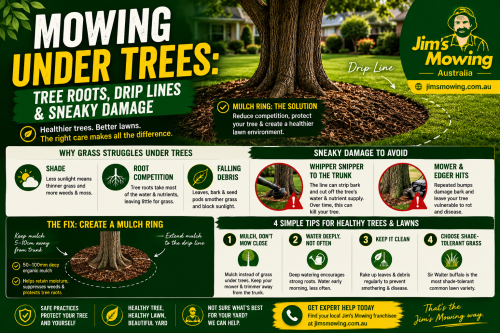
The drip line is a horticultural term you’ll see used a lot when talking about trees and lawns. It’s the imaginary line on the ground directly below the outer edge of the tree’s canopy, where rainfall would drip off the leaves.
That line matters because it roughly marks the edge of the most active root zone. The fine feeder roots that take up water and nutrients are concentrated within the drip line, often in the top 30cm of soil. Anything you do inside that line, mowing, trampling, parking the wheelbarrow, compacts the soil and damages those feeder roots.
A lawn that crosses the drip line is technically growing right on top of the tree’s most important root zone. The grass and the tree are competing for the same water in the same soil, and neither is winning.
The sneaky damage: whipper snipper to the trunk
This is the one most homeowners never think about, and it’s the cause of more silent tree deaths in Australian backyards than any pest or disease.
When you bring a whipper snipper close to a tree trunk to neaten up the grass right at the base, the line wraps around the bark and strips it. A single pass might leave a small scuff. A weekly pass over a year leaves a ring of damaged bark around the entire trunk.
Trees move water and nutrients up the inside of their bark. Strip a ring of bark right around the trunk and you’ve cut off the supply line. The tree might still leaf out for a year or two on stored reserves, but it’s slowly dying from the cut. By the time the canopy thins and you realise something’s wrong, the damage is done.
The same thing happens with lawn edgers and mower decks that swing close to the trunk. The bark at the base of a young tree is thin and easily damaged.
The fix: a mulch ring instead of grass
The solution is simple: stop trying to grow lawn under the tree and put down a mulch ring instead.
A mulch ring is a circle of organic mulch around the base of the tree, extending out toward the drip line. It does three things at once. It removes the grass competition, so the tree’s roots get more water and nutrients. It puts a barrier between the trunk and your whipper snipper, so the bark stays intact. And it holds moisture in the soil around the roots, which helps the tree through dry spells.
How wide should the mulch ring be?
Ideally, the ring extends out to the drip line of the canopy. For a small backyard tree, that might be a 1 to 1.5 metre radius. For a larger established tree, it could be 2 metres or more.
If that’s more space than you want to give up, even a 50cm to 1 metre ring is far better than mowing right up to the trunk. The key is keeping the whipper snipper away from the bark.
How deep should the mulch be?
50 to 60mm is the depth our team uses in garden beds in Western Australia, where Peter, our WA regional franchisor, runs a deeper mulch because of the climate. In other states, anywhere from 50mm to 100mm of mulch is standard. Too thin and weeds push through. Too thick and water can struggle to reach the roots underneath.
Keep the mulch off the trunk
This is the rule that homeowners get wrong most often. Don’t pile mulch up against the trunk like a volcano. Leave a 5 to 10cm gap between the mulch and the bark.
Mulch piled against the trunk holds moisture against the bark, which rots it. It also gives pests an easy run up into the tree. The “volcano mulch” look you see in some gardens is one of the worst things you can do for a tree.
A flat, even ring with the mulch held back from the trunk gives the tree the moisture and protection without the rot risk.
What if you’ve already got bare patches under trees?
If your lawn is already thinning under a tree, there are two options. The right one depends on how much grass is left and how dense the shade is.
Option 1: try to grow grass. If the shade is light to moderate, a shade-tolerant variety like Sir Walter buffalo can sometimes recover. Our Sir Walter buffalo care guide covers the conditions where it does well. Selectively pruning the canopy to let more light through helps too, and the hedge trimming guide covers the basics on tree and hedge work. The Jim’s hedge trimming and pruning service handles the bigger jobs.
Option 2: switch to mulch or ground cover. If the shade is too heavy or the roots too dominant, give up on grass and plant shade-tolerant ground covers instead. Our ground cover plants for Australia guide walks through varieties that handle low light and dry soil.
Option 2 is usually the better long-term call. Fighting nature for a green carpet under a deep-shade tree wastes water, fertiliser and weekends.
The right way to mow what’s left
Where you do still have grass close to a tree, the Jim’s lawn mowing service approach is straightforward.
- Mow first, edge last. Get the bulk of the lawn done with the mower, then come back with the whipper snipper for any tight spots.
- Don’t whipper snip the trunk. Keep the cutting head clear of the bark by at least 10 to 15cm. If grass is growing right up to the trunk, accept a small ring of uncut grass rather than damage the tree.
- Lift the mowing height under trees. A slightly taller cut helps the shaded grass photosynthesise more of what little light it gets. Refer to our mowing height cheat sheet for the right range by grass type.
- Rake off leaf litter regularly. Don’t let it sit on the lawn for weeks at a time.
- Avoid mowing wet ground under the canopy. Shaded ground stays wet longer, and wet mowing compacts the soil and damages the grass.
Read this article to know more about Landscaping Around Trees: Professional Tips for Beautiful, Functional Tree Surroundings.
When to call in a pro
If you’ve got mature trees, established mulch rings that need refreshing, or you’re not sure where the drip line falls on your block, your local Jim’s franchisee can take a look and lay out a plan. We handle the regular mowing, the edging that keeps the lawn looking sharp without damaging the trees, and the seasonal mulch top-ups.Want a thicker, healthier lawn without the weekend grind? Get a free, no-obligation quote from your local Jim’s Mowing team today. Call 131 546 or book online to get Jim’s lawn mowing service sorted properly, with the tree-friendly approach your backyard needs.