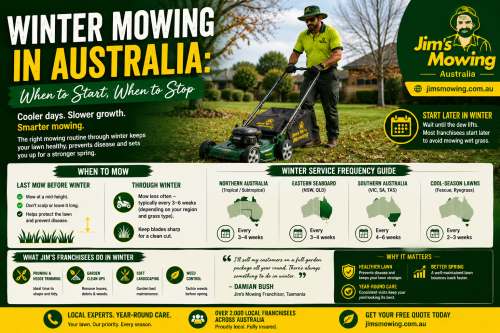
If you’re wondering whether to keep mowing through winter or just put the mower away until September, you’re asking the right question. The answer depends on where you live, what grass you’ve got, and what you want the lawn to look like come spring. In most parts of Australia, mowing through winter is a “less often, but don’t stop entirely” job. In some climates, you can pause altogether. This guide breaks down when to start, when to stop, and how Jim’s franchisees handle the off-season for thousands of households across the country.
Does grass actually need mowing in winter?
Short answer: it depends on your climate zone and your grass type. Long answer involves a bit of plant biology.
Cool-season grasses like fescue and ryegrass keep growing through the cooler months. They’re the green-all-winter type, common in southern Victoria, Tasmania and the cool-temperate pockets of NSW. They still need mowing through winter, just less often than in summer.
Warm-season grasses, which is most lawns across Australia, slow down or go dormant in winter. Couch, kikuyu, buffalo and zoysia all drop their growth rates as the soil cools. Some go fully dormant in cold districts and turn brown until spring. Others just tick along quietly.
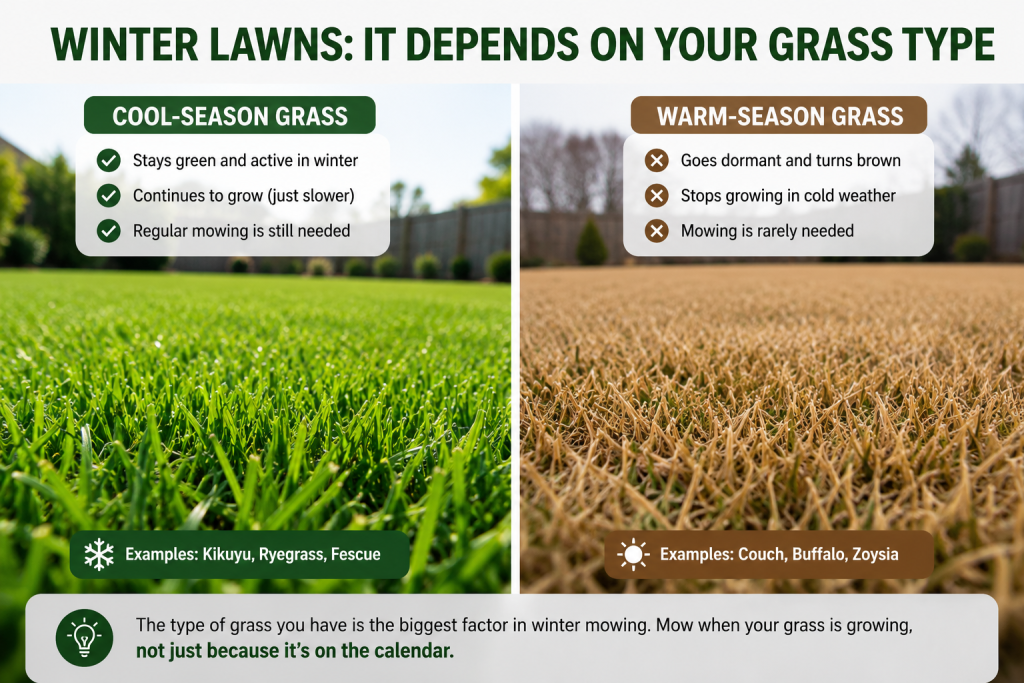
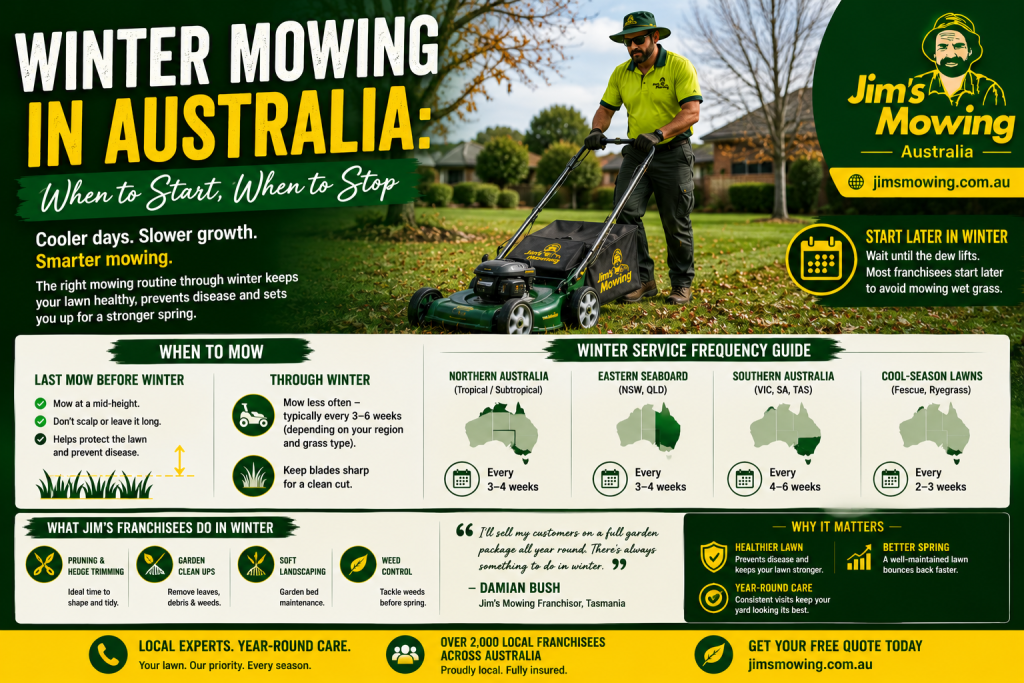
The practical takeaway: most lawns still need an occasional mow through winter, but the frequency drops a long way from what it was in summer. Once a month, sometimes once every six weeks, is plenty for a lot of warm-season lawns. Cool-season grasses might still need a mow every two to three weeks.
The “start later in winter” rule
There’s a habit our franchisees pick up across the country: in winter you start the day later, because the lawn isn’t ready for the mower at 7:30am.
“”We don’t start in winter as early because there’s no use because of the dew we get around at the moment. So I start like 8:30 in that area. In summer we try and start a bit earlier, 7:30 trying to be on site.””
— Craig, Jim’s Mowing Denham Court, on the Jim’s Mowing podcast
That’s not just a routine for franchisees. It’s good advice for anyone with a lawn. Mowing wet, dewy grass clumps the clippings, clogs the mower, leaves uneven cuts, and can spread fungal issues across the lawn. Wait until the dew has lifted before you start.

In frost-prone areas the wait can be longer. One of our regional NSW franchisees in Orange has to wait until after 9am most winter mornings for the frost to lift before he can even start. Frosted leaf is brittle and crushed by the mower, then turns brown where it’s been damaged. Patience pays off.
When to do the last mow before winter
The “last mow” before winter sets the lawn up for the cold. The principles are simple:
- Don’t scalp it. Going too short in the last mow lets cold air sit on the soil, lets weeds in, and leaves the lawn stressed going into its slow-growth period.
- Don’t leave it long either. Long grass in winter mats down, traps moisture, and breeds fungal disease.
- Mid-height is the sweet spot. Bring it down to roughly the height you’d run it at through autumn, but no shorter.
For most warm-season lawns, that’s somewhere between 30mm and 50mm in southern states, depending on grass type. Cool-season lawns can sit a touch taller through winter to keep photosynthesis going.

Our broader lawn care calendar Australia goes deeper on the month-by-month timing for each climate zone.
How Jim’s franchisees use winter
Winter is where the difference between a casual lawn business and a Jim’s franchise becomes obvious. Casual mowers go quiet in June, July and August, then scramble back to work in September. Jim’s franchisees plan for it.
Damian Bush, our regional franchisor in Tasmania, has the cleanest version of this strategy in the network. His pitch to customers isn’t “mowing service.” It’s “full garden package, all year round.”
“”I’ll sell my customers on a full garden package all year round. All my customers, bar a couple, fortnightly customers, that does not change all year round. Now of course I’m not mowing their lawns every two weeks, but there’s always something to do. It’s a good opportunity to upsell, especially coming into the winter and autumn with your pruning, with your garden cleanups.””
— Damian Bush, Jim’s Mowing franchisor in Tasmania, on the Jim’s Mowing podcast
That’s the shape of a good winter program. The fortnightly visit doesn’t change. The work inside the visit does. Some visits are a mow. Some are a hedge trim and a clean-up. Some are pruning. Some are clearing leaves. Some are getting a garden bed back under control before spring. The customer’s lawn and garden stay looked after, and the franchisee’s income stays steady.
Peter, our regional franchisor in WA, runs a similar approach with a different name for it.
“”Soft landscaping, we do a lot of that in the winter time. So our seasonal stuff, the guys will go gardening a lot in the winter time when it’s not growing the lawns.””
— Peter, Jim’s Mowing regional franchisor (WA), on the Jim’s Mowing podcast
Peter calls it “a rainy day job in your back pocket.” If a customer asks for a garden tidy or a hedge trim mid-mowing season, he’ll book it in for the first rainy day. Mowing rounds keep flowing in dry weather. Gardening jobs fill the wet days. Income stays consistent across the year.
Service frequency in winter: what to expect

A good rule of thumb for a Jim’s regular customer through winter:
- Northern Australia (tropical / subtropical): Mowing roughly every three to four weeks through winter. Growth slows but doesn’t stop. Plenty of garden tidy work alongside.
- Eastern seaboard (NSW, southern QLD): Every three to four weeks for most warm-season lawns. Cool-season lawns every two to three weeks.
- Southern Australia (Victoria, SA, Tasmania): Mowing every four to six weeks is typical for warm-season lawns. Cool-season fescue and rye every two to four weeks. Plenty of pruning and hedge work in the schedule.
- WA (Perth and south-west): Similar to southern Australia, with the bonus of winter being the wet season, so gardening work fills the wet days.
Homeowners can also check their local climate averages to better understand how winter conditions affect lawn growth.
For homeowners on a Jim’s regular service, the visit doesn’t disappear in winter, the focus just shifts. Most franchisees are happy to fold in light pruning, garden bed tidy, or pathway clean as part of the regular slot. If you’d rather move from one-off calls to a steady schedule, our piece on lawn care subscription vs casual walks through how it works.
What to do yourself through winter
If you’re doing your own lawn through the cold months, a short checklist:
- Wait for the dew or frost to lift before mowing. Wet leaf is the problem, not cold air.
- Mow on the higher setting. Don’t scalp the lawn going into the cold.
- Keep blades sharp. Torn leaf tips brown off badly in winter.
- Lay off fertilising heavily. Most lawns can’t use the nutrients fast enough in winter and the run-off is wasted.
- Clear leaf litter and debris. A lawn smothered under wet leaves goes patchy and stressed.
- Watch your drainage. Wet winter ground is when drainage issues become obvious. If you’re seeing standing water for days at a time, the soil is telling you something. Our backyard drainage solutions guide is the next read.
- Winter is the time for hard work on the rest of the garden. Pruning deciduous trees, cleaning gutters, pressure-cleaning paths. See our pressure cleaning driveways guide for the off-season clean-up.

When to start mowing again in spring
Spring starts at different times across Australia. As a general guide:
- Northern Australia: Mowing rounds tick up from late August onwards.
- Eastern seaboard: Mid-September is when most warm-season lawns wake up.
- Southern states: Late September to mid-October is when growth properly kicks back in.
- WA: Similar to southern states, but the wet winter often means the spring flush is fast and dense.
The early spring mow is one of the most important of the year. The lawn has been quiet for months, so the first mow shouldn’t try to bring it back to summer height in one go. Lift the cut height for the first few mows, then drop it gradually as growth picks up.
Check out more articles provides helpful tips on caring for your lawn throughout the autumn and summer seasons.
When to call us
If your winter routine has slipped, or you’d rather hand the whole year over to someone who plans for it, your local Jim’s can help. We run regular accounts year-round, with the work shifting between mowing and gardening as the season demands. Our Jim’s lawn mowing service is built for this consistent year-round arrangement, and where the winter visit needs to flex into hedge trimming or a general garden tidy, our Jim’s gardening services line is on the same booking.Prefer to skip the winter mowing puzzle altogether? Your local Jim’s lawn mowing franchisee will keep your lawn and garden in shape from June through August and have it ready to fly in spring. Call 131 546 for a free, no-obligation quote, or book online to find your nearest Jim’s.