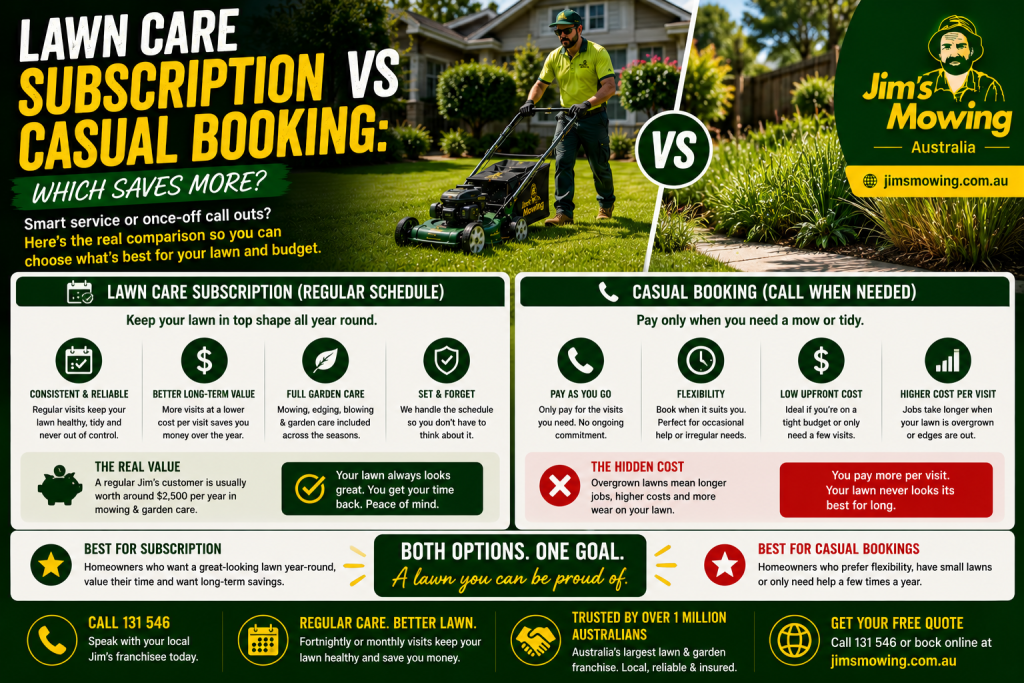
If you’re wondering whether to put your lawn on a regular schedule with Jim’s or just call when you need it, you’re asking the right question. The short answer is: it depends on the size of your yard, how fast your lawn grows, and how much weekend time you actually want back. The longer answer involves some real numbers, what a Jim’s lawn care subscription actually includes, and the cost trap most homeowners fall into when they book on a “call when it’s bad” basis. This guide walks through the comparison, the trade-offs, and where each model genuinely makes sense. We’ve also pulled in the franchisee insights that shape how Jim’s customers tend to use the two options.
What a Jim’s “subscription” actually means
Let’s clear something up first. Jim’s doesn’t run a fixed-price national subscription product in the way a streaming service does. What we run inside our Jim’s lawn mowing service is a recurring schedule, where your local Jim’s franchisee comes back to your yard on a set rhythm and you pay per visit at an agreed price. Weekly through the growing season, fortnightly through cooler months, monthly through winter for some yards, and so on.
The advantage is that your lawn never gets out of hand, the visits are usually shorter and tidier than casual call-outs, and the franchisee knows your yard well enough to spot problems early. The downside is that you’re paying through quieter weeks when the grass isn’t growing fast. For most yards across most of Australia, the maths still works in favour of the schedule, but not always. We’ll get into that below.
“Definitely diversifying. I’ll sell my customers on a full garden package all year round. Like a monthly or fortnightly retainer for different services. You’ve still got that recurring income. Now some customers go for it, some don’t go for it, but if you’re giving an all-round package, so if you’re mowing one fortnight, no worries, that’s out of the way. The next week you could be in their garden for x amount of time.”
— Damian Bush, Jim’s Mowing franchisor in Tasmania, on the Jim’s Mowing podcast
Damian’s been running this model in Hobart for years. The pitch is simple. Mow on the first visit, garden tidy on the second, hedge trim or mulch top-up on the third, back to mowing on the fourth. The lawn and the rest of the yard get attention across the year, not just in the growing months, and the customer doesn’t have to think about it.
The cost comparison: a worked example
Let’s run real numbers, with the usual caveat that every block is different and your local Jim’s will quote your yard properly.
Take a typical suburban block. Standard front and back lawn, a few garden beds, a hedge along one fence. On a casual call-out basis, a homeowner might book Jim’s three times across the warmer half of the year, when the lawn has obviously gotten away from them. Each visit is a longer job because there’s more to do. Edges have grown out. Garden beds need a tidy. The hedge needs trimming because it wasn’t done last time.
The same lawn on a fortnightly schedule through the growing season is a different shape. Each visit is shorter because the lawn’s in good shape and the edges are already sharp. The hedge gets a quick trim every few visits rather than a major job once a year. Over 12 months, the spend per visit is lower, the total visit count is higher, and the yard stays looking sharp the whole way through.
A regular Jim’s customer is usually worth about $2,500 a year when you stack up the mows and the add-on services. A once-off job might be a $300 or $500 cash injection, but it’s not continued repeat work. That’s the gap between the two models, and it cuts both ways. The customer pays more in total over the year, but they also get more service. The casual customer pays less in total, but the lawn is rarely at its best.
What a regular schedule usually includes
Recurring visits with your local Jim’s typically cover the same standard work, just on a rhythm:
- A consistent mow at the height that suits your grass type
- Line trimming along all edges every visit
- Path and driveway blow-down
- Clippings handled the same way each time
The optional adds depend on the franchisee and the season:
- Hedge trim every few visits
- Garden bed weeding and mulch top-ups
- Pruning and tree work as needed
- Pressure cleaning of paths and outdoor areas in cooler months
- Gutter cleaning where the franchisee offers it
That’s the appeal of Damian Bush’s “full garden package” model. The same fortnightly visit becomes a mowing day, then a garden tidy day, then a hedge day, then back to mowing. The customer pays the same per-visit price across the year and the yard always has something being done.
George, one of our franchisees on the Mornington Peninsula, takes a similar approach with new customers. He gives them a regular maintenance price during the first quote and most say yes, because most homeowners hadn’t thought to ask. That’s the underrated point. The cost trap of “I’ll just call when it needs it” is the default, and the franchisee mentioning a regular price up front often changes that.
When a casual booking makes more sense
A subscription isn’t right for every yard. Here’s where casual still wins.
If you mow most of the time yourself and only need Jim’s for the big stuff, a casual booking is fine. Three or four visits a year for the harder jobs, with you handling the in-between weeks, can work out cheaper than a full schedule.
If your lawn is tiny. A small courtyard that takes 15 minutes to mow probably doesn’t need a fortnightly franchisee visit. Once every month or six weeks with a casual booking can do the job.
If you’re a renter on a short lease. Locking into a 12-month schedule doesn’t make sense if you’re moving in three months. Book the end-of-lease lawn restoration when you need it instead.
If your yard is acreage and the work is genuinely seasonal. Some acreage properties only need slashing twice a year. A recurring fortnightly visit isn’t the right shape. A scheduled twice-a-year slash with Jim’s grass slashing or acreage service is.
Cancellation and flexibility
A common worry about going on a schedule is that you’re locked in. With Jim’s, you’re not. Your local franchisee runs a recurring booking, not a contract. You can pause over a holiday, skip a week if you’re away, or cancel without a fee. The network runs on the unlimited work guarantee.
Some of our franchisees have customers who’ve been with them for over a decade. Two clients who’ve been with Jim’s for around 20 years live across the road from each other in regional NSW. Same franchisee, every three weeks, year after year. That’s not a contract holding them. It’s the lawn looking the way they want it to.
Which one saves more? It depends on what “saves” means
If “saves” means total dollars across the year, casual wins for most yards. Three jobs at $X each is less than 12 jobs at a lower $Y each.
If “saves” means cost per visit, the schedule wins. The franchisee is in and out faster because the yard’s in shape, so the per-visit price is lower.
If “saves” means time and stress, the schedule wins decisively. You don’t think about the lawn or book the visit, and the family visit never sneaks up on you. It’s handled.
If “saves” means the long-term health and look of the lawn, the schedule wins again. Consistent mowing at the right height keeps the grass thick, with less stress, fewer weeds and easier maintenance year-on-year. Our lawn care calendar Australia guide goes deeper on why consistent mowing matters.
If you’re a small-yard, mow-it-yourself homeowner who only needs help with the big jobs, casual is the honest answer. For everyone else, the schedule is usually the better deal.
What the off-season actually looks like
The winter slowdown is the part most homeowners worry about. Why am I paying through July when the grass isn’t growing? The honest answer is that the schedule shifts. Most of our franchisees move customers to a longer interval in winter. Fortnightly becomes three-weekly. Three-weekly becomes monthly. And the visit itself shifts from mow-heavy to garden tidy, hedge trim, mulching and pruning, which are exactly the jobs that benefit from being done in the cooler months. Our winter mowing in Australia guide covers what changes when the grass slows down and dew sits late.
That’s the “full garden package” Damian Bush talks about. The retainer doesn’t disappear in winter, it just changes shape. By the time spring kicks in, the yard is ready for the growing season rather than starting from a backlog.
Lock in a regular schedule (or a one-off)
If your lawn’s past its prime, or if you’re ready to stop thinking about it altogether, our local Jim’s lawn mowing team can take it from tired to thriving on whichever schedule works for you. Get a free quote on 131 546 or book online.