If you’re on the committee of a townhouse complex, you run an apartment block, you manage a retirement village, or you’ve just bought into a body corporate property and you’re working out how the common areas are looked after, this guide is for you. Strata lawn mowing is a different animal from residential lawn care. Bigger blocks. Multiple owners. Insurance requirements. Communication with managers. Tight budgets. This piece walks through how the work is scoped, what’s included, how the pricing tends to work, and why Jim’s franchisees handle thousands of strata and body corporate properties across Australia.
What strata lawn mowing actually covers
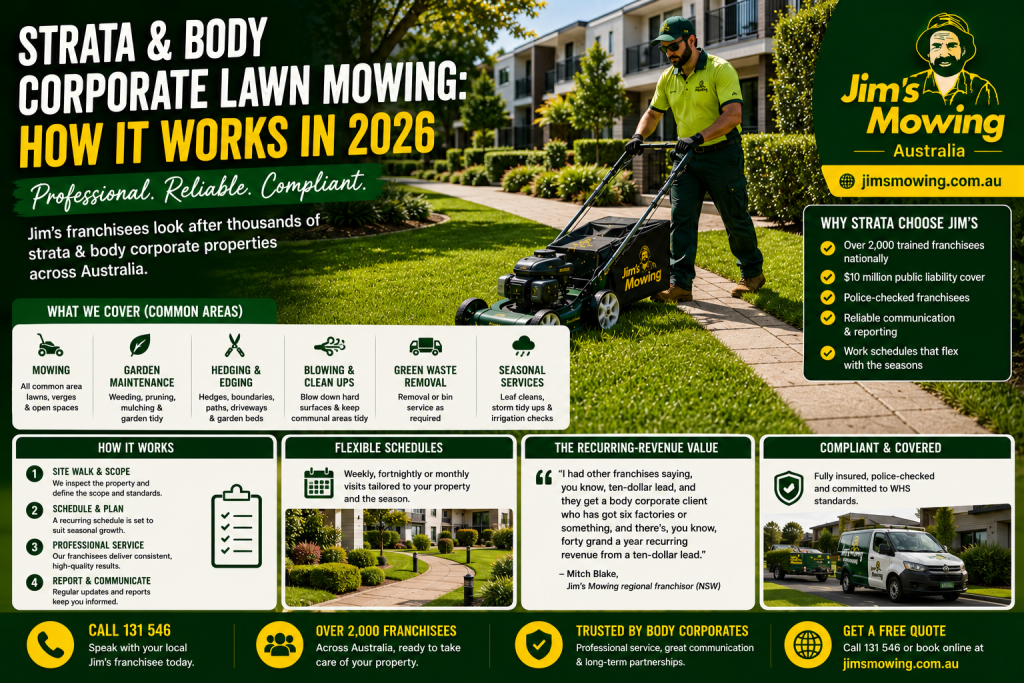
A strata or body corporate lawn mowing contract usually covers the shared external areas of a property. That’s the parts no individual owner is responsible for: the front entrance lawn, the common garden beds, the driveways and visitor parking, the walkways between units, any communal courtyards, and the boundary fences and verges.
Depending on the size and style of the complex, the work can include:
- Mowing of all common-area lawns. Front, back, side strips, verges.
- Edging of paths, driveways and garden beds.
- Whipper-snipping around buildings, fences, sheds and structures.
- Blowing off all hard surfaces. Driveways, paths, communal entries.
- Garden bed maintenance. Weeding, light pruning, mulch top-ups.
- Hedge trimming on shared boundaries.
- Removal of green waste. Either to the bin or taken off-site.
- Storm and seasonal cleanup. Branch removal, leaf clearance.
Larger contracts can also include irrigation checks, fertilising programs, pest treatments, and seasonal turf renovation. The scope is set in the contract, and the price reflects what’s in or out.
What it doesn’t cover is anything inside individual unit boundaries. Those are the owners’ responsibility, not the body corporate’s. Some complexes are mixed, where the front of each unit is owner-maintained but the back is common. In those cases the contract maps the exact zones.
How body corporate contracts are scoped
A good strata contract starts with a site walk. The franchisee meets the strata manager, the committee chair, or the body corporate manager on-site, walks the property, and lists everything that needs to be done, how often, and to what standard. For ongoing common-area work, a typical Jim’s lawn mowing contract sits on a regular schedule that flexes with the seasons. From that walk, a fixed-scope quote is built.
The work then sits on a regular schedule:
- Weekly or fortnightly in growing season. Most lawns need this rhythm through spring and summer.
- Three-weekly or monthly through cooler months. Growth slows so the frequency drops, but the work itself often shifts to garden bed tidy, pruning, and seasonal cleanup. Our winter mowing in Australia guide explains how Jim’s franchisees keep work consistent across the year.
- Quarterly bigger jobs. Hedge cuts, mulch refresh, fertilising, seasonal pruning. These are usually scheduled separately.
Communication with the committee or manager is the part that makes or breaks a strata contract. Property managers and strata managers don’t have time to chase contractors. They want a reliable franchisee they can email, get a quick response from, and trust to do the work as scoped. That’s where the Jim’s brand and the head office structure carry real weight.
The recurring-revenue value of body corporate work
This is the bit that’s worth understanding even if you’re not a franchisee, because it explains why strata work tends to be done by serious operators rather than backyard one-man-bands.
One body corporate contract can be worth more than thirty regular residential customers combined. Our regional NSW franchisor Mitch Blake has the cleanest version of this:
“I had other franchises saying, you know, ten-dollar lead, and they get a body corporate client who has got six factories or something, and there’s, you know, forty grand a year recurring revenue from a ten-dollar lead.”
— Mitch Blake, Jim’s Mowing regional franchisor (NSW), on the Jim’s Mowing podcast
A ten-dollar lead turning into forty grand a year of recurring revenue is exactly why strata and body corporate work is the scaling pathway for serious Jim’s franchisees. There’s also a story in the network about a single age-care and body corporate client worth eighty thousand a year of work to one franchisee. These aren’t unicorns. They’re what good body corporate contracts look like.
For the property side, the recurring-revenue value cuts both ways. If you’re a strata manager, you don’t want your lawn contractor to be someone who’s barely covering costs. That kind of operator disappears mid-contract, leaves jobs half-done, or chases extras for every minor request. A franchisee who values the contract is the one who keeps showing up, communicates well, and treats your property as a long-term relationship.
Insurance and compliance for strata work
Strata and body corporate properties have specific insurance and compliance requirements that don’t apply to residential mowing.
The basics:
- Public liability cover. Every Jim’s franchisee carries $10 million public liability insurance. For body corporate committees, that’s the minimum sort of cover you’d want from any contractor on site. It’s worth checking the certificate of currency annually.
- Workers compensation. Where the franchisee has employees, they carry workers comp cover. Sole-operator franchisees use personal accident cover.
- Police-checked operators. Jim’s franchisees are background-checked, which matters when contractors are on shared property with residents around.
- Branded uniforms and ID. For elderly residents and security-conscious complexes, visible branding and ID matters.
- SWMS and risk assessments. Larger commercial body corporate contracts may require Safe Work Method Statements for things like pole pruning, working at heights, or pesticide use. Jim’s can supply documentation as needed.
If you’re a strata manager comparing quotes, the cheaper sole-trader quote often misses one or more of these. The price gap usually disappears when you compare apples to apples.
Communication with committees and managers
The single most common complaint about strata contractors isn’t the quality of the mowing. It’s the communication. Missed visits, no replies to emails, surprise invoices.
A good Jim’s franchisee will:
- Respond to enquiries quickly. Most aim to return calls inside the day.
- Confirm visit dates ahead of time so managers can warn residents if needed.
- Flag issues found on site. Broken sprinklers, damaged fences, fallen branches.
- Send tidy invoices. Itemised, on time, with purchase order references.
- Be contactable when the committee wants a chat about the contract.
Strata managers tell us regularly that they wish more contractors would just answer their phone. Our Vic franchisor John Wilds is the example we use internally. His phone rings constantly during the work day with property managers and body corporate contacts. That responsiveness is what builds long-term contracts.
For body corporates moving away from casual quotes towards a steady ongoing relationship, our lawn care subscription vs casual guide covers the basics.
Jim’s National Contracts for larger portfolios
For property managers with multiple complexes across multiple states, or for large aged-care and retirement-village operators with portfolios of sites, Jim’s runs a centralised arm called Jim’s National Contracts. It handles single-account contracts that span multiple regions, with one invoice, one point of contact, and the local franchisees doing the on-the-ground work.
It’s the option used by retirement village groups, aged-care providers, large body corporate management firms, schools, councils and commercial property managers. For smaller body corporates with a single property, a direct booking with your local Jim’s franchisee is the better fit.
How strata work fits with other Jim’s services
A lot of strata properties need more than just lawn mowing. Acreage-style retirement villages and large townhouse complexes with extensive shared gardens are a good example. Our acreage mowing cost Australia guide covers the pricing logic for larger blocks.
For body corporates with elderly residents or NDIS participants on-site, the NDIS, senior and accessible lawn care guide covers how those individual arrangements work alongside body corporate contracts. And for body corporates wanting a single contractor across mowing, hedge trimming, pressure cleaning and seasonal cleanup, the Jim’s network covers most of these under one booking.
What to ask when you’re choosing a strata contractor
If you’re on a committee or you’re a strata manager and you’re putting the lawn contract out for quote, the questions worth asking each contractor:
- Insurance details. Certificate of currency, public liability amount, workers comp.
- Scope clarity. What’s in the regular visit and what’s an extra.
- Frequency through the year. What changes between summer and winter.
- Response times. How quickly emails and calls get returned.
- Reporting. How issues found on site are communicated back.
- References. Other strata properties they currently service.
- Lead franchisee continuity. Is it the same operator every visit, or will it change.
A quick conversation around those points usually separates the serious contractors from the rest.
Booking strata or body corporate lawn care with Jim’s
If you’re a strata manager, a body corporate committee chair, an owners corporation manager, or you run an aged-care or retirement village and you need a reliable lawn mowing contractor, your local Jim’s lawn mowing team handles thousands of strata properties across Australia. Call 131 546 for a free, no-obligation site visit and quote, or book online to find your nearest Jim’s franchisee.