If your backyard pitches off the back fence into a gully, or your front lawn drops three metres from the letterbox to the front step, you already know mowing it is a different job. Slope mowing is where most lawn injuries happen. It’s where most ride-on tips occur. And it’s where the wrong gear, on the wrong day, can put you in hospital. This guide covers the basics of mowing a sloped lawn safely, what kind of mower suits what kind of slope, the gear that actually matters, and the honest line where it’s time to ring in a professional.
Why slope mowing is the highest-risk lawn job
A mower on flat ground is one thing. The same mower on a slope is a completely different machine. The weight shifts, the wheels lose grip, the blade carries serious energy, and the operator’s footing changes with every step.
The numbers back this up. Mowing injuries in Australia run into the thousands every year, and a big share of the serious ones happen on slopes. Ride-on rollovers are the worst case. Slip-and-cut injuries with push mowers are more common but just as preventable.
The trick isn’t being scared of slopes. It’s knowing the line for your gear, your fitness, and your yard.
How steep is too steep for your mower
There’s no single magic angle that applies to every mower. Manufacturers publish their own guidance, and most ride-ons come with explicit warnings about slope limits. Your owner’s manual is the first place to look.
As a general guide:
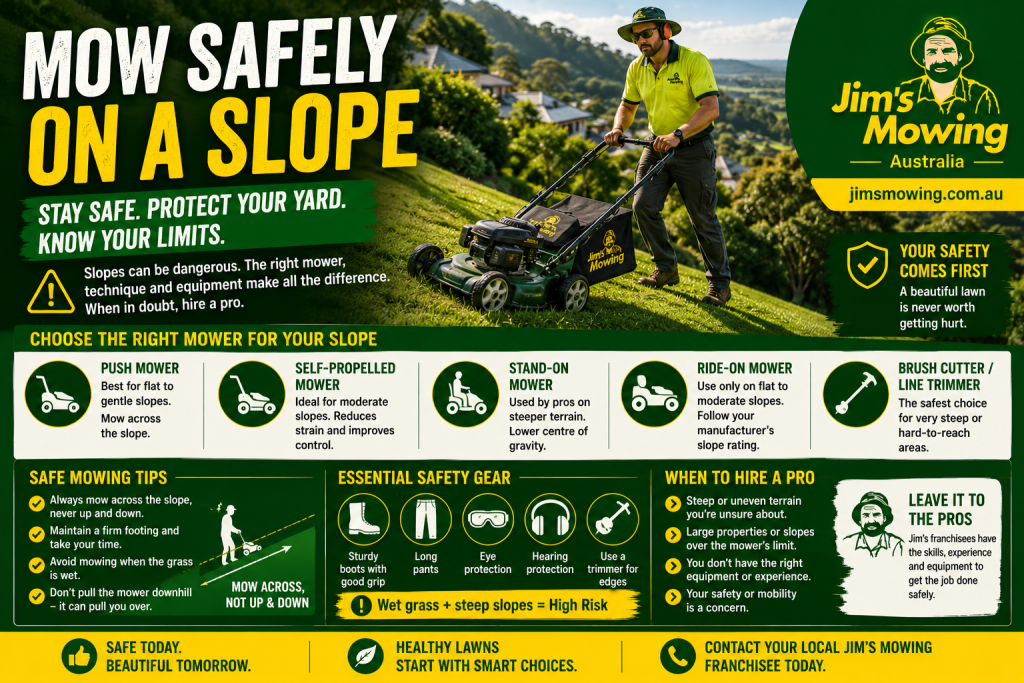
- Gentle slopes: A standard push or self-propelled mower is usually fine. Mow across the slope, not up and down.
- Moderate slopes: Self-propelled push mowers come into their own here. They take the strain off your back. Ride-ons can work but need extra caution.
- Steep slopes: This is where most domestic ride-ons stop being safe. A walk-behind, a stand-on mower, or specialty equipment is the right tool.
- Very steep, “mountain goat country”: Not the place for an amateur. This is the territory of professional slope-mowing gear and franchisees who do it for a living.
The bit that catches people out is the in-between. A yard that looks gentle from the back deck can feel a lot steeper when you’re pushing a mower across it on a 35-degree day with damp grass underfoot. If you’re hesitating at the top of the slope, that hesitation is information.
The franchisee view: knowing where the line is
One of our franchisees in the Dandenong foothills mows on slope country every week. The hills around Belgrave and Emerald aren’t gentle, and the work isn’t for first-timers. He’s also the one carrying a thirty-kilo aluminium massport mower up flights of stairs into backyards that you can’t reach with a ride-on.
“”A lot of the jobs are up on hills. You’ll get jobs where you might have a flat backyard, but you’ve got to walk up a fair few stairs and drag the mower up. I’ve got a little massport mower that I have to carry. It’s a thirty-kilo aluminium mower. It is a bit of a risk there. I know what I’m doing, so it’s all good.””
— Mitchell Dennis, Jim’s Mowing Belgrave Heights, on the Jim’s Mowing podcast
That “I know what I’m doing” is the bit that matters. Professional slope work is built on years of feel for what a slope can take, which side of the mower the weight needs to be on, and when to walk away. It’s not bravery, it’s training.
For homeowners, the version of that same line is simpler. If you’re not sure, don’t.
Mower-type-by-slope guide
A quick rundown of what works where:
- Push mower: Best for flat-to-gentle slopes. Mow across the face, never up and down. Never pull a mower toward you on a downhill.
- Self-propelled push mower: The sweet spot for the average sloped backyard. Drives itself across the hill so you can focus on footing.
- Stand-on mower (commercial): Used by some of our franchisees on hilly properties. Lower centre of gravity than a ride-on. Not domestic gear.
- Ride-on: Best on flat-to-moderate ground. On steep slopes, the risk of a rollover climbs fast. Follow the manufacturer’s slope rating.
- Brush cutter / line trimmer: The backup tool when nothing on wheels is safe. Slow but steady on the steepest country.
One of our regional franchisees was running a stand-on mower at a Bathurst property and put it this way: the gear had hit its limit, and specialty equipment was the only option. That’s an honest read from someone in the work. It’s also why a lot of slope jobs in hilly country get sub-contracted between Jim’s franchisees, with the slope specialist coming in for the trickiest blocks.
Safety gear that actually matters
You don’t need a fluoro vest and a hard hat for the back lawn. But there’s a short list of gear that makes a real difference on slopes:
- Enclosed boots with grip soles. Sneakers slip. Thongs and slides shouldn’t be anywhere near a mower. Boots with a proper sole are the single best slip-prevention tool you own.
- Long pants. Cut-grass debris off a mower comes out fast. Bare legs catch it.
- Eye protection. A small stone flicked out from under a deck at the right angle is a hospital visit.
- Hearing protection on petrol mowers. Less safety, more long-term hearing health.
- A whipper-snipper for the edges. Don’t try to mow within a metre of a steep edge or a retaining wall. Trim those bits by hand.
For ride-on owners, the seat belt and the rollover protection (ROPS) bar on most modern machines isn’t optional. If your ride-on has one, use it.
There’s also the weather to think about. Wet grass on a slope is the most dangerous combination in lawn care. If you can leave the mowing for the next dry day, do.
When ride-ons get tricky
A ride-on is a wonderful machine on flat ground. On slopes, it becomes a balancing act. Beyond the slope itself, there’s the question of heat, fuel, and the mower’s own safety systems kicking in at the wrong moment.
One of our franchisees was mowing a sloped property on a 42-degree day when the ride-on’s thermal protection cut the engine. The Walker mower has a safety mechanism that shuts the engine down at high temperatures to prevent fire risk. It worked exactly as designed, but it left a mower stranded mid-slope. That’s a small example of why slope days need extra thought, not just for the operator but for the machine.
If you’ve bought a ride-on for an acreage block, the basics still apply. Check your manual’s slope rating. Mow across, not straight up and down (zero-turns will tell you otherwise on their spec sheet, follow the manual). Slow down on turns. Don’t try to mow the steepest section on the hottest day of summer.
Our piece on acreage mowing cost Australia covers the bigger picture of when a ride-on pays for itself, and which size suits which property.
Insurance and what happens if something goes wrong
This is the bit homeowners often miss. If you injure yourself mowing your own steep lawn, your private health and any income protection are what’ll cover you. If you injure a neighbour or damage a neighbour’s property with your mower, your home and contents policy may or may not cover the mower itself, and it certainly won’t cover commercial use.
When you book a Jim’s lawn mowing service, you’re booking someone who carries $10 million in public liability cover specifically for mowing work. That’s not a paperwork detail. That’s the difference between a slope mishap being a story to laugh about later and a slope mishap being a bill that turns up six months on.
It’s also why some Jim’s franchisees decline two-storey or specialty slope work themselves, then refer it across to another Jim’s franchisee who’s geared up for it. The point isn’t to take every job. The point is to do the right job safely.
When to mow it yourself and when to call us
A simple way to think about it. If you can mow the lawn comfortably across the slope, with good footing, in dry conditions, and you’re confident on the controls, mow it yourself. If you’re hesitating, if you’ve slipped once already this season, if the mower is older and the brakes are tired, or if the slope is genuinely steep, call in someone who does it daily.
The same logic applies if you’ve got snake risk in the long grass, see our snake-safe lawn care guide for the summer rules. Long grass on a slope on a hot day is the worst case. That’s a Jim’s job, not a Saturday-morning DIY.If your lawn has gotten away from you, or the slope’s just too risky to keep tackling yourself, your local Jim’s lawn mowing team will handle it properly the first time. Call 131 546 for a free, no-obligation quote, or book online to find your nearest Jim’s franchisee.