If you’re wondering whether you’re cutting your lawn too short, you’re not alone. Mowing height is one of the most common questions our team gets, and it’s the single setting that decides whether a lawn thrives or thins out. Cut too low and you scalp the grass, open the soil to weeds and burn the colour out of it. Cut too high and you risk thatch, pests and a lawn that hides its problems. This cheat sheet covers the right mowing height for each common Australian grass, summer versus winter settings, the one-third rule, and how to avoid the most common scalping mistakes.
Why mowing height matters more than you think
Grass grows from the base, not the tips. When you cut, you’re shortening the leaf blade. The plant uses that leaf to photosynthesise, which is how it makes energy to push out new growth and keep the roots strong. Take too much off in one cut and you weaken the whole plant.
The right height does three jobs at once. It keeps the lawn dense enough to crowd out weeds. It shades the soil so it holds moisture and stays cooler in summer. And it gives the plant enough leaf to keep feeding itself, so the roots dig deeper and the lawn handles heat, foot traffic and dry spells.
Get the height wrong and you’ll see it within a fortnight. Brown patches. Bare soil where weeds appear. A lawn that needs watering twice as often because the soil is exposed. That’s why this is the first lawn-care lever to get right, before fertiliser, before watering, before anything else.
Mowing height also depends on where you live
Before we get to the grass-by-grass numbers, there’s one thing the cheat sheet won’t tell you. Cutting height is regional. What works in Perth doesn’t work in Melbourne, and what works in Melbourne is too short for parts of NSW.
“We do cut the lawns a lot shorter over here, especially compared to Victoria. We’ll cut down to 15, 20 mil height where Victoria’s 20 is very short for you guys. Average probably 25 over there.”
— Peter, Jim’s Mowing regional franchisor in Western Australia, on the Jim’s Mowing podcast
That regional difference is real and it changes how our franchisees set up their mowers across the country. Our WA team cuts closer to the ground because the climate, soil and grass varieties handle it. Our Victorian and NSW franchisees lift the deck higher so the lawn keeps moisture and colour through the cooler months. If you’ve moved interstate and your old mowing routine isn’t working, that’s why.
Mowing height cheat sheet by grass type
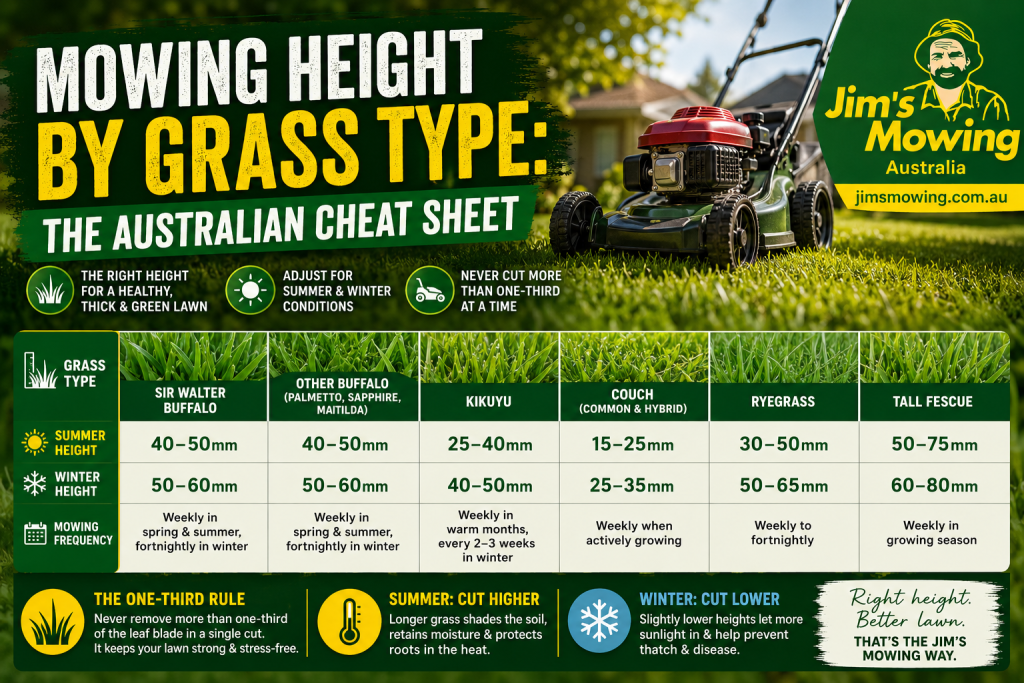
Here’s the standard guidance our team works from. These are commonly recommended ranges in Australian horticulture, not a one-size-fits-all rule, so adjust within them for your climate and season.
| Grass Type | Summer Height | Winter Height | Mowing Frequency |
|---|---|---|---|
| Sir Walter buffalo | 40–50mm | 50–60mm | Weekly in spring and summer, fortnightly in winter |
| Other buffalo (Palmetto, Sapphire, Matilda) | 40–50mm | 50–60mm | As per Sir Walter; Sapphire can run slightly shorter |
| Kikuyu | 25–40mm | 40–50mm | Weekly in warm months, every two to three weeks in winter |
| Couch (common and hybrid) | 15–25mm | 25–35mm | Weekly when actively growing |
| Ryegrass | 30–50mm | 50–65mm | Weekly to fortnightly |
| Tall fescue | 50–75mm | 60–80mm | Weekly in growing season |
Sir Walter buffalo
Sir Walter holds its colour and density best when it’s left a little longer than couch. Cutting under 35mm tends to scalp it and lets weeds in. For more detail on the variety, our Sir Walter buffalo care guide covers the full routine.
Other buffalo varieties (Palmetto, Sapphire, Matilda)
The buffalo family all sit in a similar range. Sapphire is a bit finer-leafed and some homeowners run it slightly shorter, but the upper-40s is still the sweet spot.
Kikuyu
Kikuyu is fast-growing and forgiving, which is why it’s everywhere. It can take a closer cut than buffalo but it’ll punish you with seed heads and an unruly look if you let it get too long between mows. The kikuyu vs buffalo vs couch comparison goes deeper if you’re trying to identify what you’ve got.
Couch (common couch and hybrid couch)
Couch is built for a low cut. It loves full sun and a sharp blade. In WA and parts of QLD, our franchisees will run couch at the lower end of that range. In cooler southern states, lifting the deck a touch in winter keeps the lawn from going thin.
Ryegrass
Ryegrass is a cool-season grass, so it keeps growing through Melbourne, Adelaide, Hobart and Canberra winters. Cut it on the higher side in summer to protect the roots from heat stress.
Tall fescue
Fescue is the tallest cut on this list. It’s bunch-forming, so a higher deck keeps it looking even and shades the crown from summer heat.
The one-third rule
There’s a piece of standard lawn-care advice that backs up every height on that cheat sheet: never remove more than a third of the leaf blade in a single cut. That’s the one-third rule.
If your lawn has grown to 60mm and you want it at 30mm, don’t take it down in one go. You’d be cutting half the leaf off, which stresses the plant, exposes the soil and almost always leaves a yellow or brown lawn for a week. Instead, drop it to 45mm first, wait a week, then drop it to 30mm the following mow. It takes longer but the lawn keeps its colour and bounces back faster.
This matters most after a holiday, a wet spell where you couldn’t get out there, or when you’re taking over a lawn that’s been let go. Resist the urge to “fix it” in one cut. Stage the drop over two or three mows.
Summer versus winter heights
The cheat sheet above lists summer and winter ranges, but the principle is simple. Raise the mowing height as the weather gets hot. Lower it slightly as the weather cools.
Why? Longer leaves shade the soil and keep moisture in during summer heat. A taller lawn in January handles a 38-degree day far better than a closely-cropped one. In winter, when growth slows and there’s plenty of moisture around, a slightly lower cut keeps the lawn looking neat without stressing it.
Some warm-season grasses like kikuyu and couch go semi-dormant in cold southern winters, which is why mowing frequency drops too. Our winter mowing in Australia guide covers the seasonal rhythm in more detail, including why our Tasmanian franchisor still runs fortnightly retainers all year round.
How to avoid scalping
Scalping is what happens when you cut a lawn so short the stems and crown are exposed. The lawn goes yellow or brown almost immediately. We see it most often after homeowners borrow a mower with a lower deck than they’re used to, or when they try to drop the height too aggressively in one cut.
Three things prevent it:
- Stick to the one-third rule. No exceptions.
- Check the deck setting before each season. It’s easy to leave the mower on a low summer setting going into winter.
- Watch for uneven ground. A bump or rise will get scalped first, even if the rest of the lawn is fine. If you’ve got an undulating lawn, our lawn levelling guide is the long-term fix.
For a deeper look at the damage and the recovery steps, our what is lawn scalping article walks through the rescue protocol.
What if my mower won’t drop low enough?
This comes up a lot in WA, where our team cuts to 15 to 20mm and some electric mowers won’t go that low. The answer is usually a combination of two things: choosing a mower with a lower deck range, or accepting that 25mm is your floor and adjusting the grass type or routine to suit. Our regular Jim’s lawn mowing service brings the right gear for whatever cutting height your lawn needs.
When to call in a pro
If you’re unsure what grass type you’ve actually got, or you’ve inherited a lawn from the previous owners and the height feels wrong, a quick visit from your local Jim’s franchisee will sort it out. We’ll identify the grass, set the right height for your climate, and put you on a mowing schedule that suits the season.
The right height saves you money on water, fertiliser and weed control. It’s the cheapest lawn upgrade you can make.
Prefer to skip the DIY? Your local Jim’s franchisee will cut your lawn at the right height, on the right schedule, with sharp blades and the right gear. Call Jim’s Mowing on 131 546 for a free, no-obligation quote or book online to find your nearest team and get the Jim’s lawn mowing service sorted.