If you’re wondering whether a robotic lawn mower could replace your weekly mow, you’re not alone. The tech has come a long way. The hardware is genuinely good, the price has dropped, and a robot quietly trimming your lawn while you’re at work is a real option in 2026. But a robot is not a full lawn-care service. It’s a single tool that does one thing, and there’s still plenty it can’t do. Here’s an honest look at where robots win, where they don’t, and when calling a pro still makes more sense.
The robot mower in 2026: how good has it actually got?
A few years ago, robotic mowers were a gimmick. You’d install a buried boundary wire, the robot would bump around your yard like a vacuum cleaner, and you’d hope for the best. The new generation is different. GPS-guided, no boundary wire required, app-controlled, with brands like FJ Dynamics, Mammotion and Segway pushing into the residential space. They’re quieter, smarter and they actually finish the job.
Even our own podcast guests, including industry suppliers who service the Jim’s network, have shifted their tune.
“I was a naysayer. I was one of those they’re going to take our jobs. But honestly… the way we’ve implemented it is, it’s only going at sites where we have full-time operators at. It just means that we can do high quality gardening when this little robot’s taking care of a bunch of the mowing.”
— BJ, an equipment supplier on the Jim’s Mowing podcast
BJ isn’t a Jim’s franchisee, he supplies gear to the lawn-care industry. He’s now running a robot mower at a community centre site that covers 1,500 square metres. The robot handles the mowing, and the human operators focus on whipper snipping and the higher-quality finishing work the robot can’t reach. For specialty clients who want the lawn to look 100% all the time, BJ now calls it a no-brainer.
That’s the honest framing. Robots aren’t replacing skilled lawn-care work. They’re freeing it up.
What robots are actually good at
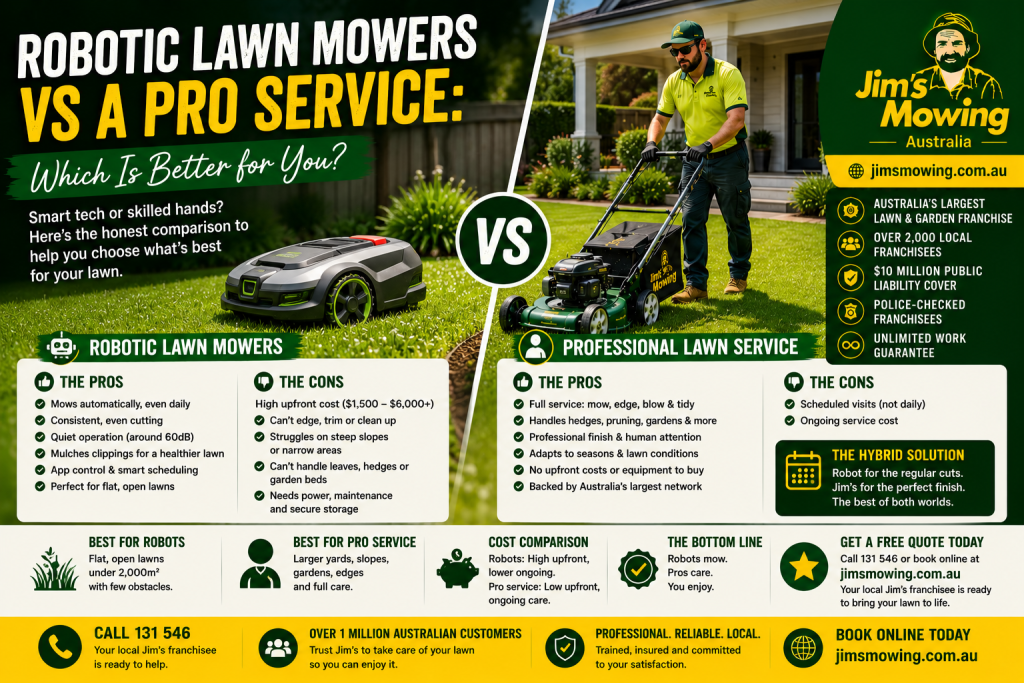
Robotic mowers do one job really well: keeping a flat, open lawn at a consistent height. If your yard is mostly grass, mostly level, and free of obstacles, a robot will:
- Mow on its own schedule, even daily, without you lifting a finger
- Keep the lawn short and even, because it cuts a tiny bit each pass rather than a big chunk weekly
- Mulch clippings finely back into the lawn as natural fertiliser
- Run quietly enough to use in early mornings or evenings without bothering the neighbours
That last point matters more than people realise. A robot at 60dB is quieter than a normal conversation. A petrol mower is 95dB+. If you’ve got shift workers next door, or a sleeping baby in the house, the noise drop is genuine.
What robots can’t do (and why pros still win)
This is where the picture gets honest. A robot mower is a mower, full stop. It doesn’t do any of the work that actually makes a lawn and garden look properly cared for.
Here’s the list of jobs a robot can’t touch:
- Edging. That clean line between your lawn and the path, kerb or garden bed. Robots can’t do it. You still need a whipper snipper or edger.
- Hedge trimming and pruning. Obvious, but worth saying. See our hedge trimming guide for what’s involved.
- Garden bed tidy. Weeding, mulching, deadheading, sweeping leaves out of beds. None of that is robot territory.
- Gutter cleaning, pressure washing paths, blower work on hard surfaces. Different tools, different jobs.
- Awkward spots. Around play equipment, water features, narrow side passages, steep slopes. Robots either skip these or get stuck.
- The “human eye” finish. Spotting a fungal patch, knowing when to skip a mow because the lawn is stressed, picking up a stray ball before it goes through the blade. That’s pro work.
So even with a robot running daily, most properties still need a person on site every couple of weeks to handle everything the robot can’t.
Cost: the upfront vs ongoing question
A decent robot mower for a small to medium suburban lawn costs anywhere from $1,500 to $4,500 in 2026. The premium models that handle larger areas and steeper terrain push past $6,000. On top of that, you’ll factor in:
- Initial setup and mapping (one-off, can be done yourself on newer GPS models)
- Battery replacement every few years
- A safe storage spot with power
- Repairs if it hits something hard or gets caught on a sprinkler head
Compare that to a regular pro service. The Jim’s lawn mowing service usually quotes per visit, and the visit includes mowing, edging, blowing down hard surfaces and a tidy. No upfront hardware spend, no batteries to replace, and the person doing the work spots problems with the lawn before they get expensive.
For a small flat backyard you barely use, the robot maths can work out over five years. For an average suburban block with garden beds, edges, hedges and the occasional tree to deal with, a pro service is usually the simpler answer. And for acreage, robots don’t yet have the range or terrain ability to be a serious option. You’re better off with our acreage and ride-on mowing service.
Lawn types that suit a robot
Robots love:
- Flat, open lawns under about 2,000 square metres
- A single uninterrupted grass area
- Couch, kikuyu and some buffalo varieties that respond well to frequent low cuts
- Properties with a power outlet near where the robot will live
Robots struggle with:
- Steep slopes over about 25 degrees
- Heavy thatch or scalped lawns that need a recovery period
- Narrow side passages between fences (the robot can’t turn)
- Lawns with lots of obstacles like kids’ toys, dog bowls or sprinkler heads
If your lawn doesn’t fit the “robot loves” list, you’re probably better off with a regular pro service. And if it does, you’ll still want a pro for the edging, hedging and garden tidy a robot can’t handle.
The hybrid model: robot for mowing, pro for the rest
This is where the industry is heading. The robot keeps the lawn at a consistent height through the week. Your local Jim’s franchisee comes every fortnight or month to handle everything the robot can’t reach: edging the kerb, whipper snipping fence lines, trimming hedges, sweeping paths, clearing gutters, and giving the lawn the once-over only a trained eye can do.
It’s the same model BJ described from his community centre site. Robot mows, humans finish. The lawn looks better, the maintenance is consistent, and you don’t lose your weekends.
When a robot just isn’t right for you
A few honest signals you’re better off skipping the robot for now:
- Your lawn is on acreage or has serious slope
- You’ve got tight side passages or lots of obstacles
- You want one trade who does the whole property each visit, not a robot plus a pro
- You’re renting (robots are an investment that doesn’t move easily)
- Your lawn is stressed, patchy or recovering and needs a proper lawn renovation before any regular mowing kicks in
For all of these, a pro service is the simpler call. Same with anyone who just doesn’t want to spend their downtime troubleshooting a robot that’s stuck under the trampoline.
So, should you buy a robot or call Jim’s?
If your lawn fits the robot sweet spot (flat, open, under 2,000sqm) and you also want hedges, edges and garden beds kept tidy, the answer is probably both. Robot for the mowing, Jim’s lawn mowing service for the rest.
If your lawn is more complex, sloped, on acreage or you simply prefer one team handling the whole job, skip the robot and go with a regular pro visit. The team turn up with the gear, the experience and the eye for what your lawn actually needs each season.
If your lawn’s past its prime, our local Jim’s experts can take it from tired to thriving. Get a free quote on 131 546 or book online to find your nearest Jim’s.