If your backyard backs onto bushland, sits at the edge of a paddock, or just has a corner where the grass has gotten away from you, snakes are part of summer in Australia. Most snake encounters in suburban yards are avoidable with a bit of planning and some sensible habits. This guide covers how to keep your lawn snake-unfriendly through the warmer months, what to do if you spot one, the safest way to mow long grass, and the simple rules our franchisees use when they’re working in snake country.
When snakes show up in suburban yards
Brown snakes, red-bellied blacks, and tigers all come out as the weather warms. Late spring through early autumn is peak activity. They’re cold-blooded, so they look for sun in the morning and shade in the heat, which means lawns, garden beds, woodpiles, sheds and compost heaps all become potential hangout spots.
Most encounters in suburbia happen because of three things: long grass, accessible cover, and a food source like mice or frogs. Tidy up any one of those and the snake’s reason for being there shrinks.
The aim isn’t a snake-free yard. That’s not realistic in most of Australia. The aim is a yard that’s clearly less attractive than the bush next door, the paddock behind, or the creek down the road.
The simple rules that actually keep snakes away
There’s no spray, no plant and no electronic device that reliably keeps snakes off a property. What works is making the yard boring to a snake.
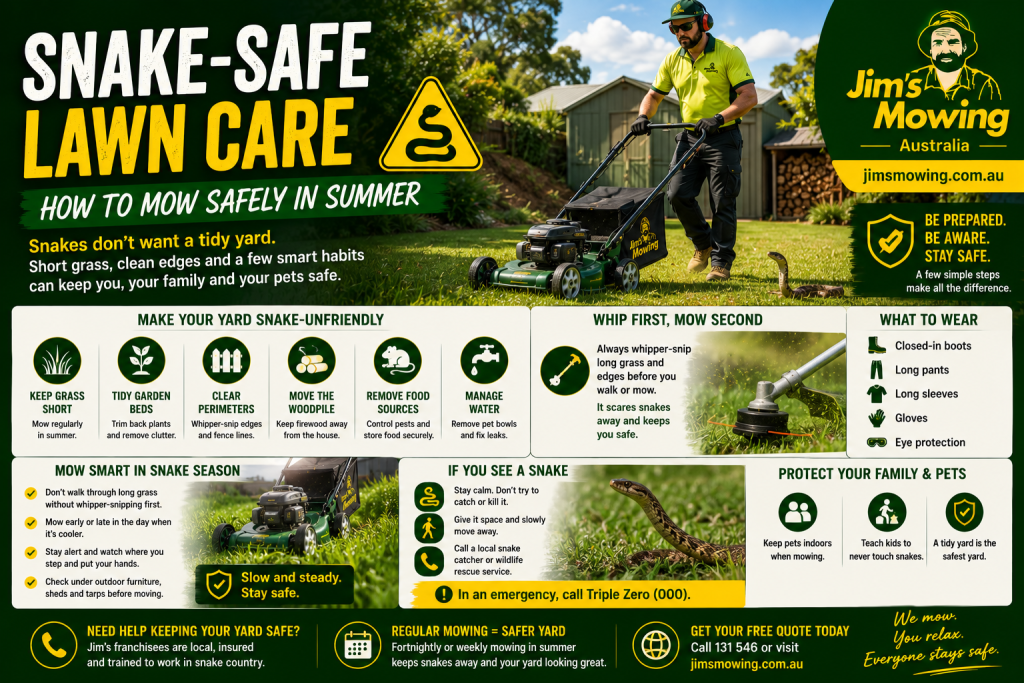
- Keep the lawn short. Snakes like cover. Long grass is cover. Short, regularly mowed lawn isn’t. The single biggest snake-prevention measure for most yards is just keeping the grass mowed at a sensible height through summer.
- Tidy garden beds. Dense, overgrown garden beds are exactly the kind of cool, hidden, mouse-friendly spot snakes like. Pruned-back beds with clear mulch are far less attractive.
- Clear the perimeters. The edges where lawn meets fence, where grass meets the shed wall, where the deck overhangs the garden, these are the snake highways. Keep them whipper-snipped and clear.
- Move the woodpile. If you’ve got firewood stacked against the house or against the fence, you’ve built a snake hotel. Move it to a dedicated spot away from the back door.
- Deal with the food source. If you’ve got mice, you’ve got a snake reason. Bait the shed, tidy the chook yard, store pet food in sealed containers.
- Watch the water. Pet bowls, leaky taps and the dog’s pool all attract snakes in dry weather. Empty what you can after use.
- Don’t leave gear lying around. Mowers, hoses, tarps, kids’ toys, all of these create overnight hiding spots.
None of this is glamorous. It’s just basic yard hygiene, done consistently through the warmer months. The combined effect is real.
The safest way to mow long grass
This is the part our franchisees take most seriously, because it’s the part that catches people out. Mowing long grass at the back of a block on a hot day in February is when most snake encounters happen.
The rule in Jim’s land is straightforward: don’t walk through long grass without whipper-snipping it first.
“This time of year in summer, don’t walk through long grass without a whipper snipper. Anything we’re scared there might be a snake, anything, I just say to the staff, just whip a snip everything, stick it in there. The heads are fifty bucks. If you break it, I’ll replace them.”
— A Jim’s franchisee, on the Jim’s Mowing podcast
The point of that quote isn’t the price of a whipper-snipper head. It’s the standing instruction. A whipper-snipper buzzing through long grass scares anything that’s in there. By the time you walk in to start mowing, the wildlife has moved on. Cheap insurance.
There’s a more vivid example of why this matters from another of our franchisees, who got called out to a snake-country property last summer.
“I went and quoted them. It was late spring, early summer. The brown snakes are starting to get active. I got to this house and there’s a whole street where they built on the top of a ridge and the backyards are just mountain goat country. They’re inaccessible and they’re overgrown and unmaintainable. The young guy that said, ‘Oh yeah, I killed a two-foot brown snake on the driveway yesterday.’ I’m thinking, that’s just what I want to hear when I’m looking at their five-foot high grass that I’ve been wading through. I was able to knock it over in four hours, which was great, and I managed to get through it without getting bitten by a snake.”
— A Jim’s franchisee, on the Jim’s Mowing podcast
Five-foot high grass on a ridgetop property with a brown snake killed on the driveway the day before. That’s a real summer call-out. The franchisee took it on, priced it for the risk, did the four hours, and walked off the job uninjured. The reason it worked was the basics. Whipper-snip everything before walking through it. PPE on. Slow and steady. Eyes open.
What to wear and what to use
For homeowners mowing long grass in snake season, sensible clothing matters more than special gear.
- Closed-in boots. No thongs, no sandals, no slides. Boots with thick uppers.
- Long pants. Loose-fit denim or work pants. Bare ankles in long grass is asking for trouble.
- Long sleeves where practical. Less for snake protection, more for spider and tick prevention.
- Eye protection on the whipper-snipper. Standard PPE for any line trimming.
- Gloves. Not strictly snake-related but useful for the rest of the cleanup work.
Beyond the clothing, the equipment matters too. A petrol or battery whipper-snipper is the single most useful snake-prevention tool you’ve got. Mowers don’t go where snakes hide. Whipper-snippers do. Use it on the edges, the perimeters, the corners and the long-grass patches before you bring the mower out.
For homeowners with hilly or steep yards where long grass is harder to manage, our piece on how to mow safely on a slope covers the gear and the line between DIY and calling in a pro. And if you’re dealing with a rental that’s been left to grow over the warmer months, the end-of-lease lawn restoration guide covers the catch-up work and pricing involved.
What to do if you see a snake
The simplest advice is the right advice: leave it alone. Most Australian snakes will move off if they’re left undisturbed.
The longer version:
- Stop what you’re doing. Turn the mower or whipper-snipper off if you can do it without sudden movement.
- Step back slowly. Don’t run, don’t stomp. Just walk away from the snake at normal pace.
- Get everyone clear. Kids and pets inside the house. Don’t try to corner the snake.
- Watch where it goes. From a safe distance, note where the snake heads. A professional catcher will want to know.
- Call a licensed snake catcher. Every state has them. They’ll come out, identify the snake, and relocate it.
- Don’t try to kill it yourself. All Australian native snakes are protected. Beyond the law, the data is clear: most snake bites in Australia happen to people trying to kill or capture the snake.
If someone has been bitten, the first response is the pressure immobilisation bandage. Wrap firmly from the bite site upwards along the limb, keep the person still, and call 000. Do not try to identify the snake by catching it. Hospitals can identify the snake from a venom test, and modern antivenoms are effective.
When the grass is too far gone
If your lawn has gotten away from you over the holiday season, after a wet summer, or because the back paddock just hasn’t been touched in months, this isn’t a DIY job. Five-foot grass and a domestic mower don’t mix, regardless of the snake risk.
That’s the territory of a heavy-duty brush cutter, a slasher, or specialised gear. For acreage and overgrown property work, our Jim’s grass slashing service is built for it. The franchisees who do this work are running 1,400-dollar petrol brush cutters with reinforced lines that go through blackberries, woody growth, and overgrown rural blocks. They’re also the people who whipper-snip the perimeter before walking in, every time.
Once the lawn is back under control, the rest of the year gets much easier. A standard fortnightly or three-weekly Jim’s lawn mowing visit through summer is the simplest snake-prevention plan you can put in place. Short, even lawn. No long-grass corners. No woodpile against the fence. Just a yard that snakes don’t bother with.
If your lawn has caught up to your knees over summer and you’d rather not be the one wading through it, your local Jim’s lawn mowing team can knock it back safely. Call 131 546 for a free, no-obligation quote, or book online to find your nearest Jim’s franchisee.