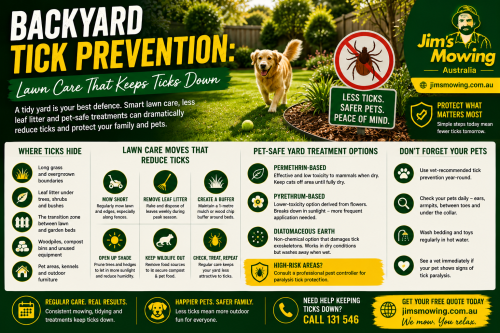
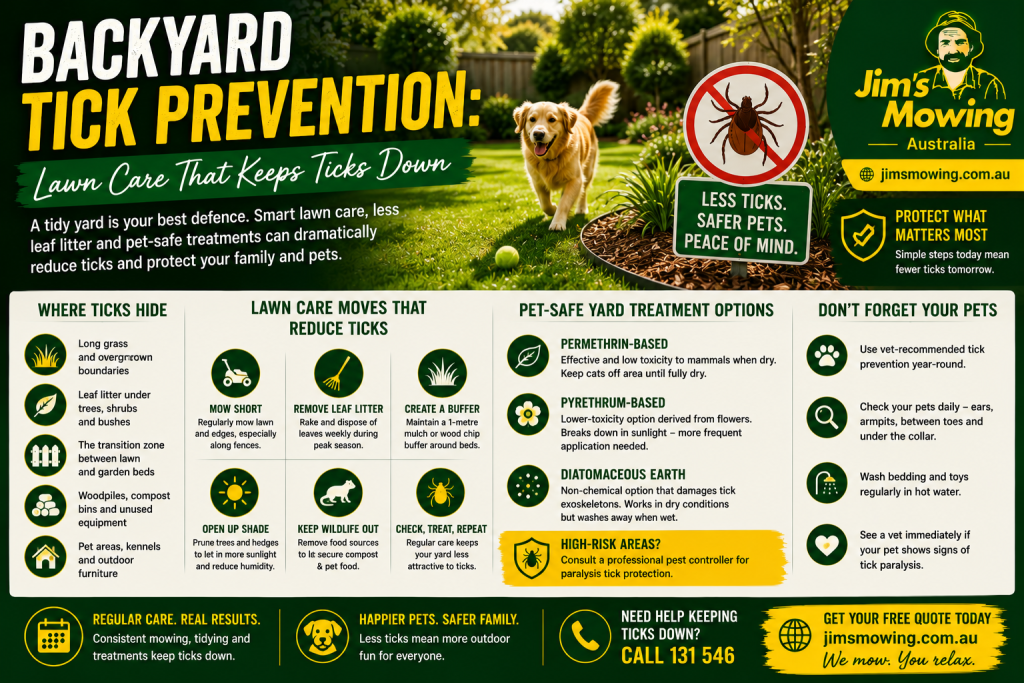
If you’re pulling ticks off the dog after every backyard play, or you’ve found one on yourself after a quick weed in the garden, your yard is doing too much of the work for them. Backyard tick prevention isn’t about chemicals first. It starts with the lawn, the leaf litter and the way your yard transitions from grass to garden bed. Paralysis ticks in particular are a serious risk for pets, and bites can be life-threatening if not caught quickly. This guide covers where ticks hide in a yard, the lawn-care moves that drop tick numbers, pet-safe treatment options, and when to call a vet or a pest controller.
Why your backyard is the front line
Ticks don’t come from nowhere. They get carried in by wildlife (possums, bandicoots, kangaroos, foxes), neighbourhood cats and dogs, and birds. Once in the yard, they wait in dense vegetation for a passing host to brush against them. They climb on, they feed, and the cycle continues.
The two factors that decide whether ticks settle into your yard are:
- Wildlife access. If possums and bandicoots are moving through your yard at night, ticks are coming with them.
- Habitat suitability. Ticks need humidity to survive. They die in dry, sunny, exposed conditions. They thrive in shaded, damp, undisturbed corners with plenty of leaf litter.
You can’t easily stop the wildlife. You can absolutely change the habitat.
Where ticks hide in a typical Australian backyard
Walk your backyard and you’ll usually find tick habitat in the same handful of spots:
- Long grass at the perimeter. Especially along fences and around sheds where the mower doesn’t quite reach.
- Leaf litter under trees and shrubs. Damp, shaded, full of cover.
- The transition zone between lawn and garden bed. Where the mulch and the grass meet, ticks can shelter in the mulch and queue up on the grass blades.
- Around woodpiles, compost bins and unused garden equipment. Anywhere that stays damp and undisturbed.
- Dense ground cover in shaded areas. Some ground covers are great. Some are tick nurseries. Heavy, damp groundcovers along fences are the worst.
- Dog kennels, outdoor furniture undersides and BBQ covers. Anywhere a pet rests or rubs against often.
If your yard has all of these, you’ve built a tick-friendly habitat without meaning to.
The lawn-care moves that drop tick numbers
This is the cheapest and most effective layer of tick prevention. The goal is to make the yard less humid, less shaded and less hospitable.
Keep the lawn mown short along the perimeter
Long grass at fences and along sheds is where ticks queue up to climb onto whatever brushes past. Keep the mowing line tight against fences. Run the whipper snipper along the entire perimeter, not just the visible front sections. The right mowing height varies by grass type, and our mowing height cheat sheet covers the standard ranges. For tick-prone yards, sit at the lower end of the seasonal range during peak tick season.
Clear leaf litter regularly
Leaf litter is tick highway and tick housing combined. It holds moisture, shades the soil and gives ticks somewhere to wait between hosts. Rake leaf piles off the lawn weekly during peak tick season (late spring through summer). Don’t leave them in heaps in the corner of the yard either, that just relocates the habitat.
Create a 1-metre buffer between lawn and garden bed
This is the simplest single change that drops tick exposure. Where your lawn meets a heavy garden bed or a fence line, put down a strip of dry mulch or wood chip a metre wide. The dry, exposed strip is hostile habitat for ticks and acts as a barrier between the dense vegetation and the area where your kids and pets play.
Open up shaded areas
If you’ve got dense shade and damp ground, that’s prime tick territory. Pruning back trees and hedges to let more sunlight through dries out the ground and makes the area less hospitable. Our hedge trimming guide covers the basics, and the Jim’s hedge trimming and pruning service handles the bigger jobs.
Keep wildlife out of pet zones
If possums and bandicoots are crossing the yard at night, they’re depositing ticks. You won’t stop wildlife entirely, but you can make pet areas less attractive. Pick up fallen fruit. Move compost bins away from pet sleeping areas. Don’t leave pet food outside overnight.
Pet-safe yard treatments
If lawn care alone isn’t enough, especially in high-risk areas of NSW and SE QLD where paralysis ticks are most common, you can add a yard treatment layer. The key word is “pet-safe”, because plenty of commercial tick treatments are toxic to dogs and cats if applied wrong.
Permethrin-based treatments are common for yard tick control. They’re effective and have a low residual toxicity to mammals when dry. But they’re highly toxic to cats during application, so cats need to be kept off the treated area until it’s fully dry (usually a few hours).
Pyrethrum-based treatments are derived from chrysanthemum flowers and are generally considered the lower-toxicity option. They break down quickly in sunlight, which means more frequent application but less residual risk.
Diatomaceous earth is a non-chemical option. It’s a fine powder that physically damages tick exoskeletons. It works in dry conditions but stops working when wet, so it’s a fair-weather tool only.
For paralysis tick areas specifically, getting professional pest control involved is usually the right call. They know the local tick load, the safe products and the right timing.
Don’t forget the pets themselves
Yard treatment is only one half of the equation. Your pets also need direct protection.
- Veterinary tick prevention products (collars, spot-ons, monthly chewables) are the front line. Talk to your vet about which product suits your dog or cat and your local tick load.
- Daily tick checks during peak season. Run your hands through your dog’s coat, check the ears, around the face, between the toes, under the collar and along the belly. Cats tend to groom ticks off themselves but still benefit from checks.
- If you find a tick on a pet, remove it carefully using tick removal tweezers or a tick hook. Don’t squeeze the body. Don’t try to burn or smother it. If your pet shows any signs of weakness, vomiting, change in voice, wobbly gait or difficulty breathing, get to a vet immediately.
What to do if you find paralysis tick symptoms
Paralysis tick bites in pets are a veterinary emergency. The signs include:
- A change in the pet’s bark or meow
- Wobbliness, especially in the back legs
- Vomiting, retching or coughing
- Difficulty breathing
- Loss of appetite
If you see any of these, the pet needs a vet now, not in the morning. Even pets on tick prevention can occasionally develop symptoms, and tick antitoxin is most effective the earlier it’s given.
For humans, tick bites are usually less serious but can cause local reactions and, in some cases, mammalian meat allergy (alpha-gal syndrome). If you’ve found a tick on yourself, remove it carefully and watch the bite site for spreading redness, swelling or any unusual symptoms.
When to bring in a pest controller
DIY yard management handles most backyards. Bring in a professional pest controller if:
- You’re in a paralysis tick hot zone and have multiple pet incidents
- Tick numbers don’t drop after a season of lawn and habitat work
- You’ve got young kids who play in the yard daily
- Wildlife traffic through the yard is heavy and you can’t reduce it
A pest controller will assess the yard, treat the high-risk zones with the right products at the right time of year, and usually advise on a maintenance schedule.
Combine it with the right lawn care
Tick prevention works best as part of a broader yard-care routine. Regular mowing, leaf clearing, hedge trimming and weed control all make the yard less hospitable to ticks without adding any chemicals. Our guides on getting rid of lawn grubs and getting rid of ants in your lawn cover the other common backyard pests, and the same principles, dry, mown, open habitat, applies to most of them.
If you’d rather skip the perimeter mowing, leaf raking and hedge work that keep ticks down, the Jim’s lawn mowing service covers the regular cutting and tidy-up that does most of the prevention work for you.
The one-line summary
Mow tight to the fence line. Clear the leaf litter. Open up the shade. Buffer the garden beds. Get the pets on a vet-approved tick product. That’s 90% of backyard tick prevention done.
Keeping your lawn at a tick-unfriendly height takes regular work, and our local Jim’s franchisees can take that off your plate. Call Jim’s Mowing on 131 546 for a free, no-obligation quote or book online to find your nearest team and get Jim’s lawn mowing service sorted with the perimeter work that makes the biggest difference.