If your lawn went brown almost overnight after a mow, you’ve probably just scalped it. Lawn scalping is one of the most common mowing mistakes Australian homeowners make, and it’s the reason a perfectly healthy lawn can look dead within a few days. The good news is it’s preventable, and most scalped lawns recover within a few weeks if you treat them right. This guide covers what scalping looks like, why it happens, the five fixes that stop it happening again, and what to do if your lawn’s already gone brown.
What is lawn scalping?
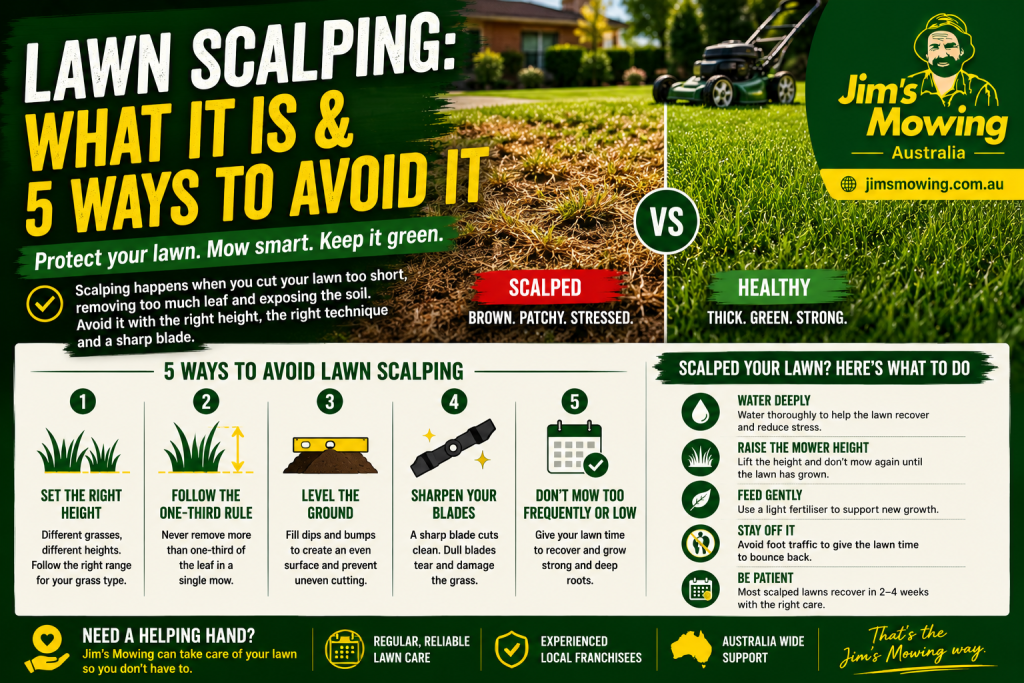
Scalping is what happens when you cut a lawn so short that the stems, crowns and sometimes the soil itself are exposed. Instead of cleanly trimming the green leaf, the mower hacks into the woody growth at the base of the plant. The lawn turns yellow or brown almost immediately, and bare patches start showing through where the grass was thinnest.
It looks worse than it usually is. A scalped lawn isn’t dead, in most cases. The roots are still alive underneath. What you’re seeing is the loss of the photosynthesising leaf and the exposed crown reacting to sudden sunlight. With the right recovery steps, the lawn will push out fresh growth within two to four weeks.
The problem is that while it’s recovering, the lawn is wide open to weeds, drying out, and pest damage. Scalping doesn’t just look bad. It sets your lawn back by weeks and gives weeds a head start that takes months to undo.
How to tell if your lawn is scalped
Scalping has a distinct look that’s different from drought stress or grub damage.
- Brown or yellow patches that appeared right after a mow. Drought tans up gradually. Scalping shows the next day.
- Exposed soil or visible stems and runners. You can see down to the dirt in patches.
- Higher spots and bumps go brown first. Anywhere the lawn rises slightly above the average gets clipped lowest.
- The dead area follows the mower path. Stripes of damage line up with the way the mower went over the lawn.
- The lawn feels uneven and stubbly underfoot. Not soft, not springy. Bristly.
If those signs match what you’re seeing, you’ve scalped it. The next question is why.
Why scalping happens
Most scalping comes down to one of four causes, and usually a combination of two.
Mowing too short for the grass type. Different grasses tolerate different cutting heights. Sir Walter buffalo at 25mm is scalped. Couch at 25mm is fine. Cutting kikuyu down to 15mm in summer will stress it badly. The right height varies by grass and season, and our mowing height cheat sheet covers the standard ranges.
Taking too much off in one cut. Even at a reasonable target height, if the lawn was 80mm and you drop it to 30mm in a single pass, you’ve removed more than half the leaf. The standard horticultural advice, the one-third rule, says never to take more than a third of the leaf off in one mow. Break that rule and the result looks like scalping even if the final height was OK.
Uneven ground. A lawn that looks flat from a distance often has bumps and dips up close. The mower deck is rigid, so it scalps the bumps and skims over the dips. This is one of the most common causes of patchy scalping and it’s easy to mistake for dead spots.
A blunt blade. A dull blade tears the leaf rather than slicing it cleanly. Torn leaves brown off at the tips and look scalped even when the height is right. Sharpen mower blades at least once a season.
The 5 ways to avoid lawn scalping
Here’s the playbook that prevents scalping for good.
1. Set the right height for your grass type
This is the single biggest fix. If you only do one thing, do this one.
- Buffalo (Sir Walter, Palmetto, Sapphire): 40 to 60mm
- Kikuyu: 25 to 40mm
- Couch: 15 to 25mm in summer, slightly higher in winter
- Ryegrass: 30 to 65mm
- Tall fescue: 50 to 80mm
Adjust within those ranges for your climate and the season. Higher in summer to shade the soil and hold moisture. Slightly lower in winter for a tidy look. For the regional differences and the full breakdown, our mowing height cheat sheet is the quick reference.
2. Follow the one-third rule
If the lawn has grown taller than you’d like, don’t try to fix it in one cut. Drop it in stages.
Lawn at 70mm and you want it at 40mm? First cut to 55mm. Wait a week. Then cut to 45mm. Then 40mm. Three mows over three weeks, lawn keeps its colour.
This matters most after holidays, wet spells when you couldn’t get the mower out, or when you’ve taken over a lawn that was let go by the previous owner.
3. Level the ground
If your lawn is bumpy, scalping is almost inevitable. The bumps get clipped to the soil, the dips don’t get cut at all, and the lawn looks patchy even when the height is right.
Light top-dressing with washed sand a few times a year evens out the surface gradually. Bigger dips need cutting out and filling. For the full process, our how to level your lawn guide walks through the steps.
4. Sharpen the blades
A blunt blade is the silent scalper. It tears the leaf instead of slicing it, and torn leaves go brown at the tips within days. From a distance it looks just like scalping.
Get the blade sharpened at least once a season, more often if you mow weekly or hit rocks and roots. If you’ve got a battery mower with replaceable blades, swap them when they get dull rather than running them down.
5. Watch for cumulative damage
A lawn doesn’t always scalp from one mow. Sometimes it’s three or four mows at slightly too-low height, in summer heat, on a stressed lawn. Each cut takes a little more off than it should, and the lawn never quite recovers before the next mow.
If your lawn is looking thin and stubbly even though no single mow seemed too aggressive, lift the height by 10 to 15mm and skip one cycle to let it recover.
What to do if your lawn is already scalped
If the damage is done, don’t panic. Most scalped lawns recover. The recovery steps are simple:
- Stop mowing for two to three weeks. Let the leaf regrow before you cut again. Then take only the top off, no aggressive cutting.
- Water deeply. A scalped lawn loses moisture fast because the soil is exposed. Deep watering helps the roots push out new growth.
- Hold off fertiliser for the first week. Then a light, slow-release feed to support recovery. A heavy hit of nitrogen on a stressed lawn can make things worse.
- Check for weeds. Scalping opens the door for weeds. Pull hand-pull what you can early. Avoid selective herbicides until the lawn has recovered.
- Consider top-dressing the worst spots. A light layer of soil or washed sand on bare patches helps the runners knit back across.
For lawns that don’t bounce back after 4 to 6 weeks, a fuller lawn renovation might be needed. Severely scalped lawns occasionally need patching or, in rare cases, re-laying sections of turf.
How to scalp-proof your lawn long-term
The lawns we see scalped over and over usually share three traits: uneven ground, the wrong height for the grass, and an owner who tries to “make up” for missed mows by cutting hard. Fix all three and scalping stops happening.
Our local Jim’s franchisees see scalped lawns most often after homeowners drop the mower deck too low between mows. The fix isn’t complicated. Right height, right rhythm, sharp blades, and stage the drop if the lawn’s gotten away from you.
If the lawn is still struggling after recovery, it might be a thatch issue, compaction or dry patch making things worse. Wetting agents for lawns help with moisture issues, and Jim’s lawn mowing service covers the regular cutting at the right height for your grass type.
When to call in a pro
If you’ve scalped a lawn, tried the recovery steps and it’s still patchy after a month, it’s worth getting a set of eyes on it. There may be an underlying issue, thatch, compaction, dry patch, or grub damage, that’s holding the recovery back.Prefer to skip the DIY? Your local Jim’s franchisee will mow your lawn at the right height, on the right schedule, with sharp blades and the right gear for your grass type. Call Jim’s Mowing on 131 546 for a free, no-obligation quote or book online to find your nearest team and get Jim’s lawn mowing service sorted properly.