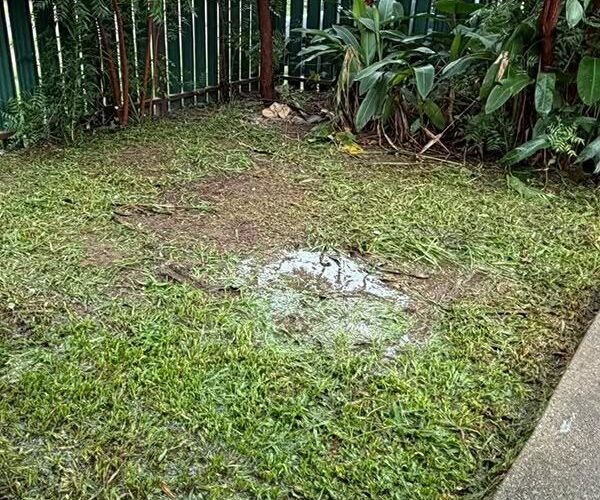
The rain has stopped and you have a soggy lawn after rain. Every step leaves a print that fills with water, and there are areas that are still holding puddles.
What you do over the next two days matters more than anything you do the following month, and it decides whether you end up with a boggy lawn every winter. Most of the lasting damage from a waterlogged lawn is not done by the water. It is done by people walking on it.
First, Stay Off It
Saturated soil has no structure. The spaces between soil particles that normally hold air are full of water, so any weight compresses the soil into a dense, airless mass.
Roots need oxygen. Compacted, waterlogged soil has none, and that is what actually kills grass after flooding rather than the water itself.
So the first instruction is the one nobody likes. Keep off it. No mowing, no kids, no dog, no wheelbarrow, and definitely no vehicles. Every footprint is a compacted spot that will still be there next summer as a hard patch that will not grow.
If you must cross, use boards to spread the load.
Do Not Mow It
Mowing a saturated lawn does three things, all bad.
The mower wheels compact wet soil more effectively than feet do. The blades tear rather than cut wet grass, leaving ragged ends that invite disease. And the machine itself can bog, rut the lawn and throw mud everywhere.
Wait until the surface is firm enough to walk on without leaving deep prints. If the grass has got long in the meantime, take it down in stages rather than all at once, because scalping a stressed lawn compounds the problem.
Help the Water Leave
Once you can move around without sinking, there are a few useful things to do, and our guide on recovering a lawn after flooding covers the longer haul.
- Clear the drainage paths. Blocked drains, silted grates and debris damming a natural flow line are often the reason water is sitting where it is. This is the fastest win available.
- Break up the surface where water is pooling. Once the ground is firm enough, forking or aerating the worst areas opens channels for water and air. Doing this too early, while the soil is still saturated, causes smearing and makes things worse. Wait until it is damp rather than sodden.
- Do not add sand or soil to level the low spots yet. Filling a puddle without addressing why it is a puddle just moves the problem, and adding a different soil type on top of clay can create a layer that traps water.
Watch for What Comes Next
Waterlogged lawns commonly develop follow-on problems, and knowing what to look for saves time.
- Fungal disease. Extended leaf wetness plus warm weather is the ideal setup for several lawn diseases. Watch for patches with defined edges appearing in the week or two afterwards.
- Yellowing. Heavy rain leaches nitrogen out of the root zone. A lawn that goes pale after a big wet is usually hungry rather than diseased. A light feed once it has dried out helps, but do not feed a lawn that is still underwater.
- Silt and debris. If floodwater deposited a layer of silt across the lawn, that layer can seal the surface. It needs raking off rather than being left to settle.
- Moss and weeds. Both move into the thin, compacted areas left behind. That is next season’s job, and it starts with fixing the compaction.
Why the Same Areas Flood Every Time
If your lawn is not draining and the same areas flood every time, the issue is not the rain.
- Compacted soil, often from years of traffic, which stops water moving down through the profile.
- Heavy clay that drains slowly by nature. Read more about heavy clay.
- Grading that runs water towards the lawn rather than away, often from a driveway, path or roof.
- Downpipes discharging onto the lawn instead of into drainage.
- A thick thatch layer holding water at the surface.
- No fall in the lawn itself, so water has nowhere to go.
Those are fixable, but they are proper drainage jobs rather than quick fixes. Aeration, soil improvement, regrading a low area, or installing subsurface drainage depending on what is actually causing it.
The Order that Works
Stay off it. Wait for it to firm. Clear the drains. Aerate the worst areas once it is damp rather than saturated. Feed once it has recovered. Then deal with the underlying cause before the next wet season, not during it.
Same patches flooding every time it rains? Your local Jim’s Mowing team can work out why and sort the drainage properly. Call 131 546 for a free quote or book online.