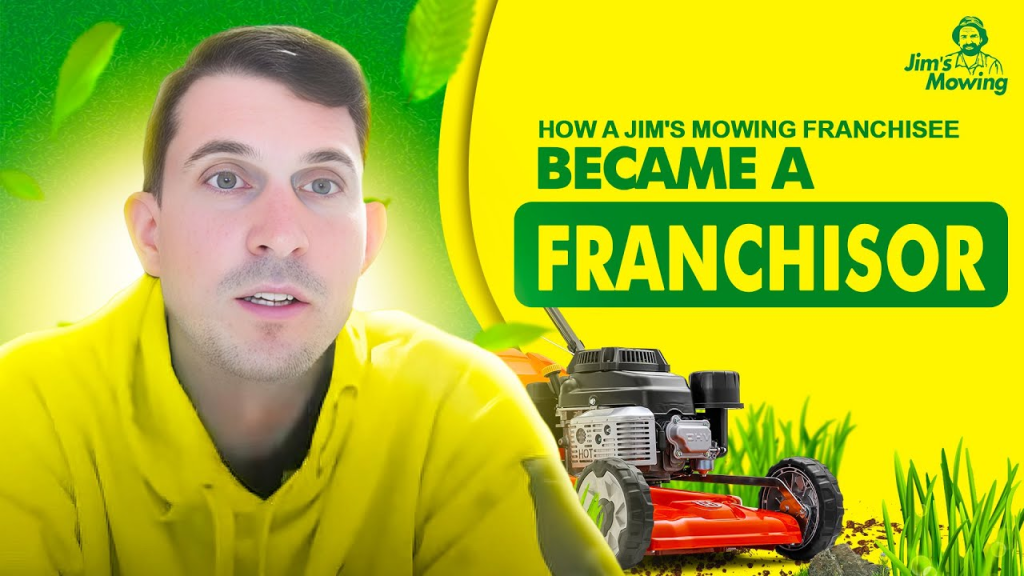
Within two years, Mitch Blake went from nearly selling his business to becoming a franchisor in regional New South Wales. The shift came from better pricing, stronger support, smarter systems, and a model that gave him both demand and structure.
In short: Mitch Blake, based in Dubbo, nearly gave up on his Jim’s Mowing franchise about a year in. Then he repriced 15 clients, later raised prices on 25 more, rebuilt the value of the business, and within two years moved into a franchisor role. The story is backed by real numbers: a starting point of about $30,000, a $2,500 pay-for-work guarantee, and solo operator revenue expectations of $2,500 to $7,000 a week.
In this More Than Just Mowing Podcast episode, Dubbo-based Jim’s Mowing franchisee Mitch Blake explained how he went from working in the mines on a 12-day-on, 2-days-off roster to building a stronger mowing business, repricing 15 clients and then 25 more, and becoming a regional New South Wales franchisor within two years. His story shows how Jim’s Group systems, like Jim’s Online, pay-for-work guarantee, observation days, and weekly franchisor support can turn a flat business into a more profitable, more structured operation.
A Jim’s Mowing franchise can be worth it when the operator treats it like a business, prices properly, and uses the support around them. Mitch Blake’s story is a good example because the turnaround was not built on hype. It was built on pricing, accountability, lead flow, and support.
What Did Mitch Do Before Starting a Jim’s Mowing Franchise?
Before Jim’s, Mitch was working in the mines on a harsh roster. He says he was doing 12 days on and 2 days off, with a young family at home.
That mattered. He wanted more family time and more value for his effort.
Even after joining, the early version of the business was not right yet. About a year in, he put the business up for sale because mowing did not feel like it was “kicking goals” for him.
The problem was not the brand. The problem was the structure of his own business, especially pricing.
Why Choose a Jim’s Mowing Franchise Instead of Working Independently?
Mitch makes a useful distinction. He did not lose faith in Jim’s Group. He says he still loved the brand, the model, and the people around him.
What kept him in was support. Dan Cahill helped him price the business. Other franchisees challenged his assumptions. Observation days, mentoring, and regular contact gave him feedback he would not have had alone.
That matters for anyone looking to own a Jim’s franchise. A franchise only works if it gives you more than a logo. In Mitch’s case, it gave him people who could spot the real problem before he sold a decent business too cheaply.
It also gave him brand trust. In Dubbo and across regional New South Wales, that trust mattered in lead generation, networking, and commercial work.
What Are the First Months Like in a Jim’s Mowing Franchise?
The first few months were intense.
Mitch says that only about eight weeks into business, he had 15 mows in a day and another 10 leads came in. He came home exhausted and asked for the leads to be turned off.
That sounds like a good problem, but it also shows what new franchisees run into. Volume alone does not fix the business. You still need pricing discipline, route control, and clear expectations.
He also says it can take around six to seven weeks to grow the business properly. That is a more realistic picture than pretending everything clicks in week one.
Early on, he also made the same mistake many new operators make. He priced too low.
How Much Can You Earn with a Jim’s Mowing Franchise per Week?
Mitch says new solo operators should think in terms of $2,500 to $7,000 a week in revenue, depending on how much they work, how well they price, and how they run the business. He also says profit margins can sit around 50 to 70%.
He also explains the $2,500 pay-for-work guarantee. If a new operator is not hitting that level, the guarantee is there as a support mechanism. Mitch is blunt about it. He wants franchisees to use it properly, report their work, and stay accountable.
That lines up with what readers usually want from how much you can earn with a Jim’s franchise. The answer is not one number. It depends on pricing, effort, route density, follow-up speed, and how well you use the system.
Mitch’s strongest proof point is not a single weekly income figure from his own books. It is a fact that repricing changed the whole business. First, he raised about 15 client prices. Then, after another push, he raised prices across 25 clients. His response was simple: now he had a good business.
How Did Mitch Turn Around His Jim’s Mowing Franchise in 2 Years?
Growth did not come from one lucky break.
It came from better pricing, better brand leverage, and better support.
In Dubbo, Mitch says the area ended up with more than triple the leads over a year once there were more and better Jim’s Mowing operators on the road. That is important because many prospects assume more trailers mean less work. His experience says the opposite. Better visibility brought more demand.
He also points to local demand in regional NSW. Ulladulla, for example, was showing about 66 leads a year without any advertising. That gave him confidence that the market was there.
Networking also drove growth. He says one new franchisee who did the right things early got 8 or 9 residential mows and access to a client worth about $80,000 a year because he built relationships fast.
That is not luck. That is system plus camaraderie.
What Systems, Tools, and Support Do Jim’s Mowing Franchisees Get?
The strongest technical advantage is the combination of Jim’s Online, territory controls, and the lead-response system.
Mitch explains that franchisees can expand their “all areas” to take more work, then shrink them later to tighten routes and improve profit. He also talks about “geospace”, which allows more targeted service areas, including commercial or acreage zones.
Why does this work?
Because a mowing business gets stronger when travel falls, and job density rises. Early on, you may need a wider catchment area to stay busy. Later, you want to bring the area in, reduce wasted travel, and build a more compact round.
The second system is the lead fee. In Mitch’s region, he describes it as $10 per lead. He openly says that when a paid lead comes in, he calls it within about two minutes. If it is just a Facebook message or a magnet enquiry, he is more likely to delay.
That is the technical point many people miss. The lead fee is not just a charge. It is a behavioural trigger. It pushes faster response times, which improves conversion and customer service.
The third system is support. Mitch describes the franchisor as providing weekly contact, accountability, marketing support, and problem-solving help. He also plans 10 meetings a year, with training built in. That is the practical side of franchisee training at Jim’s, and it is why a Jim’s Mowing franchise is more than a starter kit.
If you are weighing costs, this also gives context to how franchising fees work. The fees only make sense if they drive leads, support, accountability, and faster growth. Mitch’s account suggests that, in his region, they do.
What Challenges Do New Jim’s Mowing Franchisees Face Early On?
The biggest challenge was not mowing. It was mindset.
Mitch says he nearly sold because he was not getting enough value from the work. Then he discovered the problem was his own pricing.
He also had physical setbacks. Shoulder and knee injuries made extra ad hoc jobs harder, which pulled income down.
Then there was the normal pressure of starting a business. Too many leads, too quickly. Too much travel early on. Uncertainty about how to structure the round. The feeling that you are buying a job instead of building a business.
His answer to all of that was simple. Price properly. Ask for help. Network hard. Use the support that is there.
Is a Jim’s Mowing Franchise Worth It for New Business Owners?
Mitch’s answer is yes, but not because it is easy.
It is worth it because it reduces the risk of figuring everything out alone.
You get brand recognition, local marketing, accountability, territory flexibility, observation days, training, and access to people who have already solved the problems you are about to hit.
That is the bigger point in Mitch Blake’s story. Jim’s Group did not magically fix the business for him. It gave him the framework and the people to fix it faster.
Jim’s Mowing Franchise vs Independent Lawn Business
| Feature | Standard Operator | Jim’s Professional |
| Training | Learns alone, often by trial and error | Observation day, training, meetings, weekly support |
| Leads | Must generate work from scratch | Branded leads, local area marketing, pay-for-work support |
| Systems | Manual route building and slower optimisation | Jim’s Online, all areas, geospace, accountability |
| Branding | Must build trust from zero | Established Jim’s Mowing brand recognition |
| Income Consistency | Depends heavily on self-generated work | Supported by leads, referrals, contracts, and pricing guidance |
“I raised prices across 25 clients. And wow, did I have a good business at the end of that.”
— Mitch Blake, Jim’s Mowing Regional Franchisor
Frequently Asked Questions
Mitch says solo operators can do about $2,500 to $7,000 a week in revenue. He also says profit margins can be around 50 to 70%, depending on pricing and how the business is run.
Mitch says the advertised starting point was about $30,000 for a basic setup, including trailer, mower, blower, whipper snipper, and hedger. He also says that the figure can come down if the new operator already owns useful equipment.
Mitch describes it as a $2,500 support mechanism for new operators. He also makes the accountability point clear: franchisees need to submit the work they have done and use the system properly.
No. Mitch explains that operators can expand their service area, take work further out, and later shrink the area to improve route density and profitability. Jim’s Online and geospace settings are part of that.
He says a paid lead gets an immediate response, often within two minutes. That faster follow-up improves customer service and conversion.
The support Mitch describes includes observation days, formal training, weekly contact with the franchisor, meetings, marketing support, and help with problems inside Jim’s Online. He also points to referrals from other franchisees and work from Jim’s National Contracts.
Mitch says many prospects worry about bookkeeping and setting up a business, but he frames the real step as making the enquiry. His point is that once you enquire, you are no longer doing it alone.
Key Takeaways
- Mitch Blake nearly sold about a year in, then turned the business around by repricing 15 clients and later 25 more.
- About $30,000 to start, a $2,500 pay-for-work guarantee, and a $2,500 to $7,000 weekly revenue range for solo operators.
- In Dubbo and regional NSW, brand visibility and more trailers on the road helped drive more demand, not less.
- Jim’s Online territory controls, fast lead response, and weekly support are practical advantages, not just brochure points.
- The strongest lesson is simple: treat it like a business, not just a mowing job.
How to Start a Jim’s Mowing Franchise
Get a Free Jim’s Mowing Quote in Dubbo and Regional NSW
If you need a reliable mowing contractor in Dubbo or regional New South Wales, the value in this story is not just franchise growth. It is the operating standard behind it. The Jim’s Mowing model is built around response time, professional presentation, repeat systems, and customer trust, backed by the Jim’s Mowing service network and the Jim’s National Guarantee.
Request your free quote from Jim’s Mowing today.
Start a Jim’s Mowing Franchise and Build a Profitable Local Business
Mitch Blake’s story is useful because it is not a polished overnight win. It is a real Dubbo and regional NSW business story about low pricing, hard lessons, better systems, and stronger support.
Learn more about joining Jim’s Mowing at jims.net or call 131 546 today.