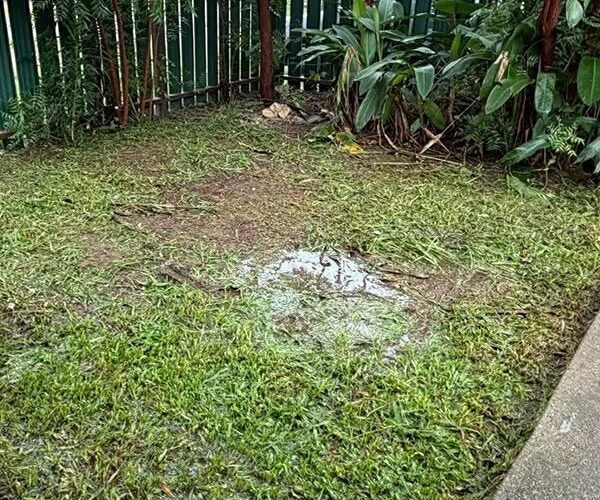
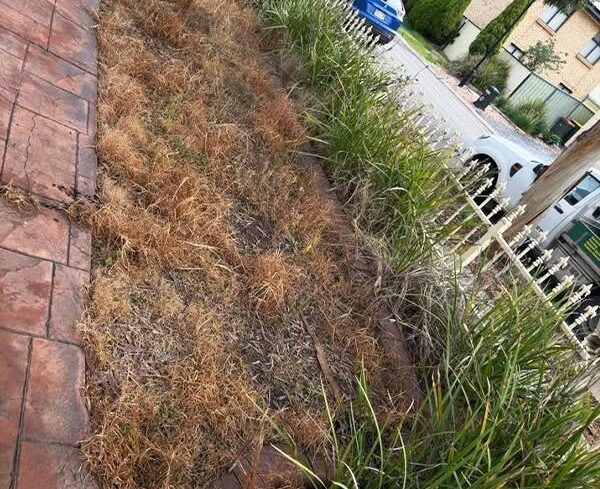
A patch of your lawn has gone brown, and you are trying to work out what is wrong with your lawn. That is the symptom, and it is the same symptom for three completely different problems.
Getting this right matters more than it sounds, because lawn disease in Australia looks a lot like drought stress and a lot like grub damage, because the standard reaction to a brown lawn is to water it more. If the cause is drought stress, that helps. If the cause is fungal disease, you have just made the conditions better for the fungus. And if the cause is grubs, you are watering a lawn that no longer has roots.
So before you do anything, it is worth spending five minutes working out which one you are dealing with.
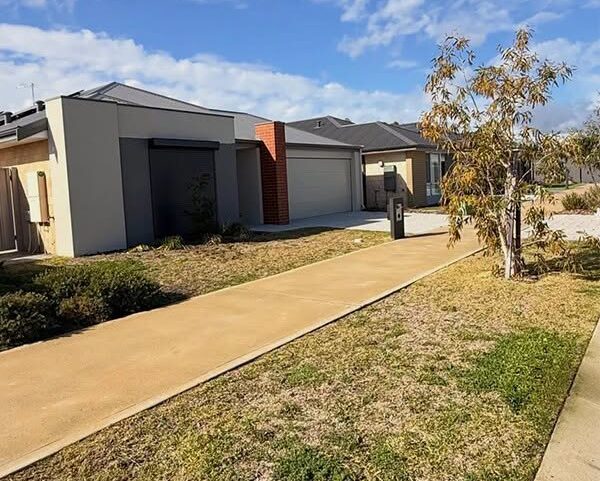
Four Tests to Work Out What Is Wrong
– Test One: The Tug Test
Take hold of the grass in the affected patch and pull gently upwards.
If it lifts away like a loose rug, with no root resistance, you have a grub problem. Our lawn grub identification guide covers what to look for. Something has eaten the roots. Healthy grass, even drought-stressed grass, is anchored. Grass with no roots is not.
This is the fastest and most useful test there is, and it takes seconds.
– Test Two: Look at the Edges
Sharply defined patches with a distinct edge point towards disease. That is the first thing to check when you are weighing up lawn fungus or grubs. Fungal problems tend to produce circles, rings, arcs or clearly bordered areas, because the fungus is spreading outward from a point.
Vague patches that fade into healthy grass point towards drought or heat stress, which is one of the more common brown patches in lawn causes. Water shortage does not draw lines. It shows up worst where the soil dries fastest, which is high spots, sandy areas, near paths and driveways, and anywhere the sprinkler does not quite reach.
Irregular patches that expand quickly, over days rather than weeks, point towards insects.
– Test Three: Check the Blades
Get close and look at individual grass blades rather than the patch as a whole.
Lesions, spots or banding across the blade suggest disease. Several common lawn diseases leave visible marks on the leaf itself, sometimes with a distinct colour edge.
Blades chewed, ragged or shortened suggest something is eating them rather than something is infecting them.
Blades that are whole but dull, folded or greyish, and footprints that stay visible after you walk across suggest water stress. That last one is a genuinely reliable early warning. Well-hydrated grass springs back. Thirsty grass does not.
– Test Four: When Did It Appear
Timing narrows it down further.
After a run of warm, humid weather, especially with overnight moisture, disease becomes far more likely. Most lawn fungi need leaf surfaces to stay wet for extended periods, which is why evening watering causes so many problems.
During a dry, hot stretch, worst in the most exposed areas, points to drought.
In spring and through summer, often with birds suddenly taking a strong interest in your lawn, points to grubs. Birds tearing at the turf are not damaging it. They are telling you what is underneath.
What Each Problem Actually Needs
- Drought stress needs deeper, less frequent watering rather than a light daily sprinkle, which encourages shallow roots. Early morning is best, because the leaf dries during the day. It also needs the underlying cause addressed if there is one, such as compaction or hydrophobic soil that repels water instead of absorbing it.
- Fungal disease needs the opposite instinct. Reduce leaf wetness, water in the morning rather than the evening, improve airflow and drainage, avoid heavy nitrogen while the lawn is infected, and treat with an appropriate fungicide if it is spreading. Mow affected areas last and clean the mower afterwards so you are not carrying it across the whole lawn.
- Grub damage, such as army worms, needs an insecticide applied at the right stage of the insect’s life cycle, followed by lawn repair, because the roots are gone and the grass will not simply recover on its own.
Get the diagnosis wrong and every one of those actions makes at least one of the other problems worse.
The Mistake that Causes Most of the Damage
Watering harder is the default response to a lawn looking unwell, and it is the correct response to exactly one of these three problems.
On a fungal issue it extends the period the leaf stays wet, which is the single condition most lawn diseases need. On a grub issue it does nothing at all, because the plant cannot take the water up.
If you are unsure, the tug test first, then the edges, then the weather of the last fortnight. Those three usually get you there.
When It Is Worth Getting Eyes on It
Some of this is genuinely hard from photos and descriptions, and a few problems look almost identical until you know what to check.
The practical advantage of having someone who works on lawns every day is that they have seen the same patch on a hundred other properties, in your climate, at this time of year. That context does most of the diagnostic work.
Jim’s franchisees are on lawns across the country all week, and several have horticultural backgrounds behind them. Working out what is actually wrong is usually a quick job for someone who has seen it before.
Not sure what is happening to your lawn? Your local Jim’s Mowing team can diagnose it properly and treat the real cause. Call 131 546 for a free, no-obligation quote or book online.