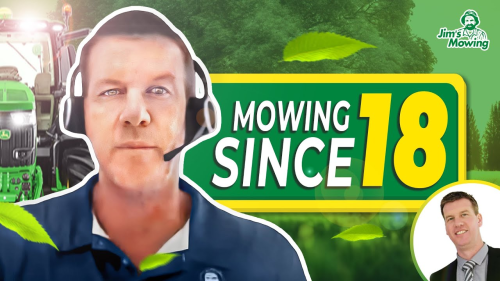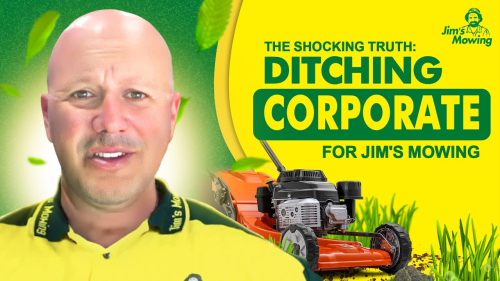

After 20 years in telecommunications, Nathan Willason left the Adelaide commute behind and built a Jim’s Mowing business in Hahndorf with 72 regular clients, 126 five-star ratings, and a four-day booked week.
In short: Nathan Willason left a 20-year telecommunications career and built a Jim’s Mowing franchise in Hahndorf, South Australia. He had grown to 72 regular clients, maintained a perfect 5-star rating from 126 reviews, and structured the business around four booked days a week plus flexible space for profitable one-off work.
In this More Than Just Mowing Podcast episode, Nathan Willason, a Jim’s Mowing franchisee in Hahndorf, South Australia, who left a 20-year Telstra career and built a regional run of 72 regular clients using Jim’s Jobs, simple text systems, and disciplined customer communication. He was doing 8 to 10 jobs a day, holding a perfect 5-star rating from 126 reviews, and working fewer hours while maintaining the income level he reached in year one.
This story shows that a Jim’s Mowing franchise can become a practical, flexible business for someone leaving corporate work. Nathan’s proof is not hype or theory. It is a real regional round, built client by client in Hahndorf, with visible systems, clear habits, and repeatable results.
What Did Nathan Do Before Joining Jim’s Mowing?
Nathan spent more than 20 years in telecommunications with Telstra. His last role involved a lot of travel, and that was the breaking point.
He was living outside Adelaide but commuting into the city. That meant roughly two hours a day on the road, often leaving in the dark and getting home in the dark during winter.
With three daughters at home, he stopped and asked a blunt question: is this actually how he wanted to spend his time? The answer was no.
Nathan already had about 1,500 square metres of lawn at home. He enjoyed mowing, fertilising, edging, and keeping it looking sharp. That pride in his own property became the clue that pointed him towards a different kind of work.
Why Did Nathan Choose a Jim’s Mowing Franchise?
Nathan did not spend months bouncing between brands. He thought of Jim’s first.
That matters. Brand trust was part of the decision from the start. He jumped online that night, sent an enquiry the next morning, and got a call back from Shane within about 15 minutes.
He then spent a couple of days out in the field and decided this was the path. For someone comparing buying your own franchise with starting from scratch, Nathan’s story shows the value of fast response, visible support, and a name customers already know. Jim’s official franchise material also frames the model as structured support with room to grow.
His wife had real reservations at first. That is another reason this story feels credible. It was not a blind leap. It was a family decision weighed against time, stress, commuting, and the reality of three kids still growing up.
What Were Nathan’s First Few Months Like?
The first few weeks were intense.
Nathan says his biggest fear was whether he would get enough work. Instead, after the first week, he was drowning in leads. He says he was getting 7 to 12 leads a day and, after about two weeks, asked for the leads to be turned off because he could not keep up with quotes.
At first, he was staying up until midnight doing quotes. Then he built a simple system: keep notes, copy and paste the quote details, add the price, and send.
After about 3 to 4 weeks, he felt a rhythm forming. After 6 months, in his words, it was “game on”.
How Much Can You Earn With a Jim’s Mowing Franchise?
Nathan’s first-year income was “really good”. Later, after pulling back on hours and reducing workload, he says he was still making the same amount of money as in that first year.
That suggests better pricing, better client selection, and better time use, not just more grinding. For readers comparing this story with how much you can earn with a Jim’s franchise, Nathan’s example shows that business quality matters as much as sheer volume. Jim’s Group also says its Pay for Work Guarantee gives franchisees a minimum income safety net of at least $1,200 per week.
How Did Nathan Grow to 72 Regular Clients?
Nathan had 72 regular clients and says the number usually floats between 70 and 80. In Hahndorf and the surrounding regional area, the jobs are bigger, so he does 8 to 10 jobs a day rather than trying to cram in 15 to 20 smaller metro jobs.
That matters because growth in a regional Jim’s Mowing franchise looks different. Bigger blocks, larger yards, ride-on work, acreage jobs, and more travel between stops mean each client can carry more weight.
Nathan also does not book himself out 100%. He works four booked days a week, usually between 7:30 and 3:30 or 4:00, and leaves one weekday open for profitable one-off clean-ups, rubbish removals, or catch-up work after rain.
That one decision is a big part of why the business now feels more controlled. He can move a wet Monday into the spare day instead of sacrificing the weekend.
What Systems Helped Nathan Build a 5-Star Business?
Nathan’s biggest edge is not fancy marketing. It is systems.
He uses Jim’s Jobs for scheduling, invoicing, and day-to-day admin, with Xero handling the accounting side. He invoices from his phone at the end of each job instead of going home to paperwork.
His communication system is simple and excellent. Every night, he texts each customer with their service window for the next day. If rain is forecast, he uses a wet-weather version. If he is even slightly late, he messages again.
This works for three reasons. First, it reduces uncertainty for the customer. Second, it gets the site ready before he arrives, including toys moved and dog mess cleaned up. Third, it makes Nathan look reliable before the mower even starts.
He makes that process fast by using iPhone keyboard shortcuts. Typing a short code fills in the whole message template, so he is not rewriting the same text over and over.
The deeper technical advantage is that he has turned communication into a repeatable operating system. Many operators treat messages as an extra task. Nathan treats them as part of the service itself.
He also uses an OBD vehicle tracker to see where he was, how long he spent on each job, and where time was lost. That helps with route review, time audits, and complaint protection. In one case, tracker data and call records helped prove he had attended a job exactly when he said he would.
For someone weighing up Jim’s franchisee training, this is the key lesson: good systems do not have to be complicated. They have to be used every day.
What Challenges Did Nathan Face and Overcome?
The first challenge was confidence. Nathan came from telco, not horticulture or small business ownership.
The second was volume. Too many leads sounds like a good problem, but it can still bury a new operator if quoting, scheduling, and follow-up are messy.
The third is weather. Nathan is clear that rainy days and cold mornings still test your patience. But he built the business to absorb that stress better by not booking every available hour.
He also worked hard to improve his client list over time. Some customers are too restrictive, too time-consuming, or too hard to schedule efficiently. After three years, he says he now has more than 70 really good clients who understand how he works.
Is a Jim’s Mowing Franchise Worth It?
Nathan’s answer is yes.
Not because every day is easy. He says any job has bad days. But he also says that 99% of the time, he wakes up happy to go to work.
That is a strong result. He has more flexibility, less commuting, more family time, and a client base that values the work.
He also talks about something many corporate workers miss: direct job satisfaction. He feels like he is genuinely helping people, and that clients see the difference.
Jim’s Mowing Franchise vs Independent Lawn Business
| Feature | Standard Operator | Jim’s Professional |
| Training | Often self-taught and built through trial and error | Nathan entered through Jim’s support, online training during COVID, franchisor guidance, and local operator advice |
| Leads | Must generate demand alone | Nathan says he received 7 to 12 leads a day early on through Jim’s |
| Systems | Can be ad hoc with scattered quoting and invoicing | Nathan runs scheduling and invoicing through Jim’s Jobs, with Xero for accounts |
| Branding | Must build trust from zero | Nathan chose Jim’s first because it was the brand he already knew |
| Income Consistency | More exposed to empty weeks and patchy client flow | Nathan built 70 to 80 regulars, keeps one flexible day open, and blends regular work with one-off jobs |
“Being my own boss has enabled me to do that. Plus, it also gives me the rewards of the harder I work, the more money I make.”
— Nathan Willason, Jim’s Mowing franchisee in Hahndorf
Frequently Asked Questions
Nathan reached a point where he was earning the same as his first year while working fewer hours, which points to stronger pricing and better business design.
Nathan did not come from a mowing background. He came from telecommunications, but he enjoyed lawn care personally and was willing to learn, ask questions, and lean on support.
Very quickly, in Nathan’s case. He says he was getting 7 to 12 leads a day early on, felt overwhelmed in week one, and started finding a flow after about 3 to 4 weeks.
Nathan’s best systems are simple: Jim’s Jobs, Xero integration, pre-written customer text messages, and time tracking through his vehicle. Together, they reduce admin, improve communication, and make it easier to quote and review performance.
Yes, and Nathan’s Hahndorf story is a good example. Regional runs can mean fewer stops per day, but bigger properties, larger lawns, and stronger value per client.
Nathan’s experience was online because of COVID, but he still leaned on his franchisor and local operators. Jim’s Group says new franchisees are trained in tools, quoting, app use, and handling first customers before they go live.
Key Takeaways
- Nathan left a 20-year Telstra career and built a Jim’s Mowing franchise in Hahndorf with 72 regular clients.
- He grew fast, going from overwhelmed in week one to a workable system within about a month.
- The real engine of the business is not just mowing skills. It is communication, quoting discipline, and repeatable admin systems.
- Regional work can be highly viable because bigger jobs support a smaller but stronger client base.
- The business gave Nathan more family time, more control, and less commuting without sacrificing income quality.
Get Started With Jim’s Mowing
Book a Trusted Local Service
If you want a local operator who shows up, communicates clearly, quotes properly, and leaves the place looking sharp, Nathan’s story explains why many homeowners choose Jim’s Mowing services.
Request your free quote from Jim’s Mowing today.
Build Your Own Flexible Business
Nathan’s story is not about overnight riches. It is about replacing a draining routine with a structured business that rewards effort, improves flexibility, and can be shaped around family life.
Learn more about joining Jim’s Mowing at jims.net or call 131 546 today.